The Notorious Death Of Doommlord The Legend

feanor's mud gossip

I continue to work my way through the box of old Commodore 64 floppy disks that I recently uncovered in the loft.  A number of the disks are barely readable and I’ve been employing a number of tactics to retrieve the files.

Although the disks don’t appear too dirty it’s clear that in some cases multiple passes of the drive head over the disk surfaces have been successful in scouring through the muck and reaching the data.  Of course that muck has to go somewhere and some of it inevitably ends up on the head.

The 'Thumb' Technique

The ‘Thumb’ Technique

I have therefore also taken the opportunity to carefully clean the heads with isopropanol alcohol a couple of times during the process.  Some of the disks that at first attempt would not even give up their directories are now yielding recoverable data.

For some of the more stubborn files I’ve employed a further technical solution, judicious use of my thumb.  At the first sign of problems when attempting to read a file, usually disk thrashing, I push the disk up in the drive with my thumb and this will often allow the read to continue.

I still have a few files that seem unrecoverable, however I may try multiple passes with Starcommander running on my PC as a last throw of the dice.  Fortunately the surfaces of the disks are not, at least to the naked eye, deteriorating too much.

Modem Internals

Modem Internals & Dirty Contacts

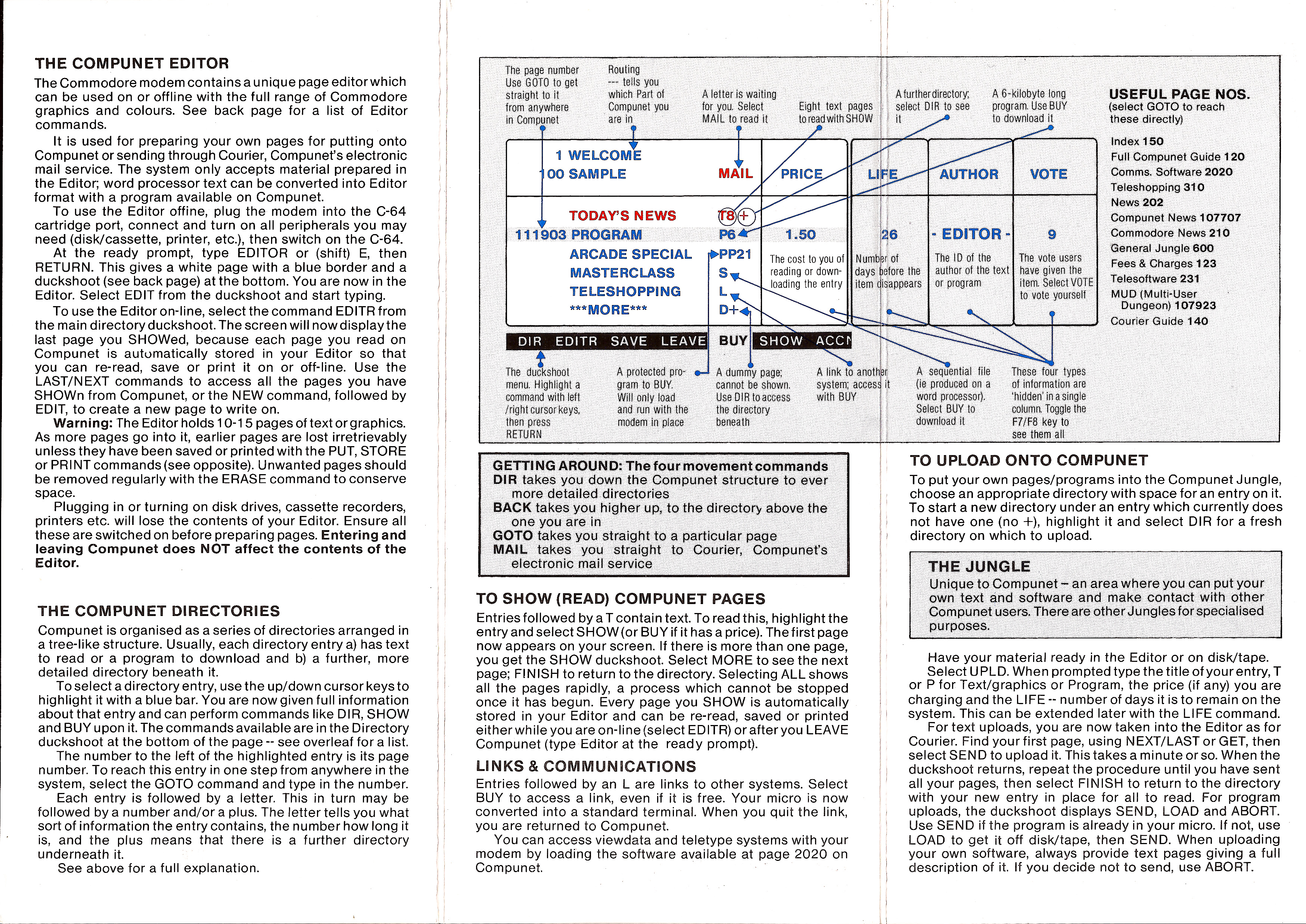
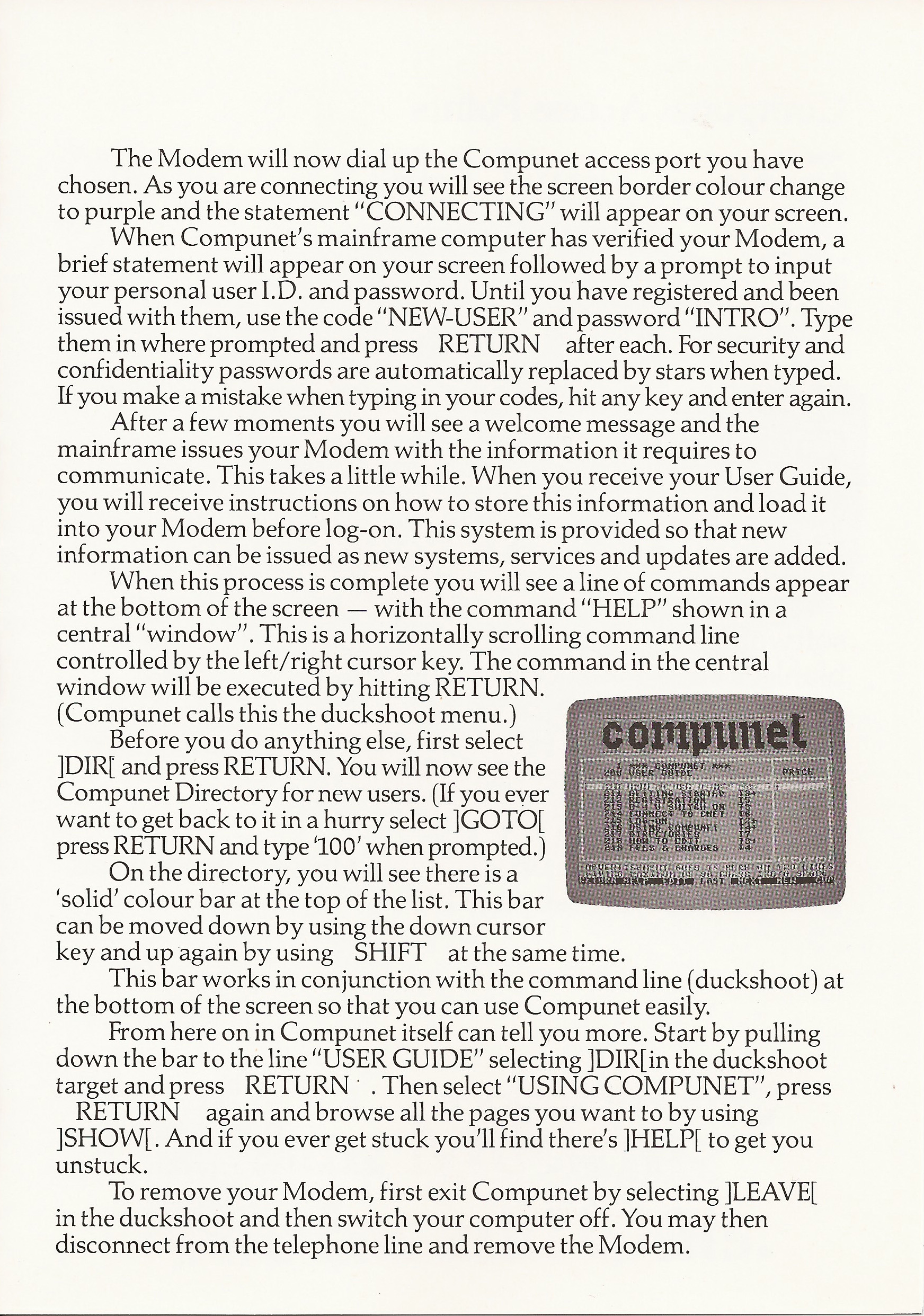
Some of the files are of the .SEQ variety and these are tied in to the built-in editor of the Commodore Communications Modem which was required to connect to Compunet.

Initially my model of this modem was not working correctly so I was unable to view the files.

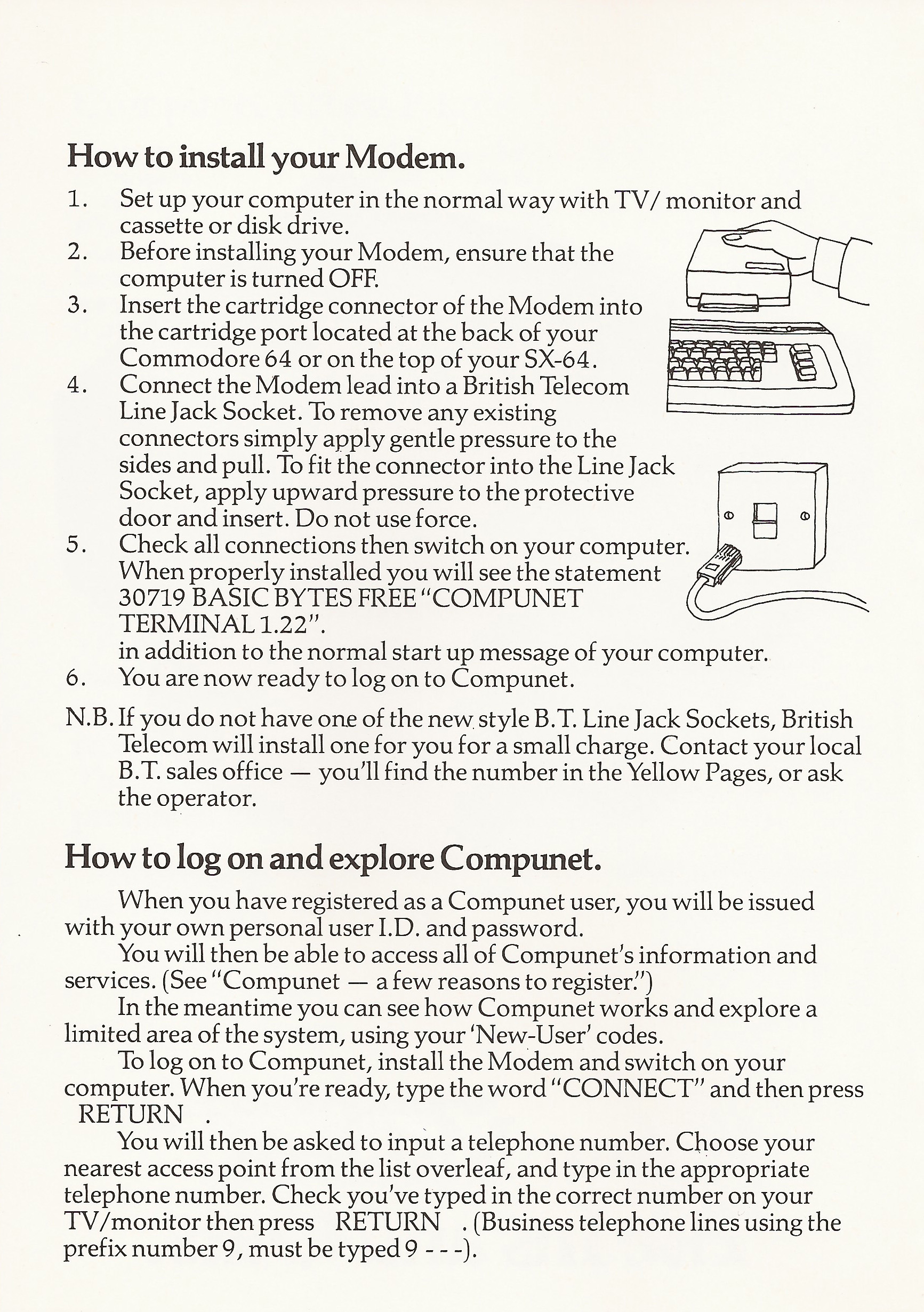
However Crys over at the Compunet Facebook Group suggested cleaning the contacts on the modem with a pencil eraser.  This did the trick and on reconnecting the modem to the 128 (forcing it in to 64 mode) I was greeted by the Compunet Terminal boot up page.

Recovering Files

Recovering Files

Typing ‘Help’ brings up the list of available built-in commands:-

  • EDITOR
  • CONNECT
  • CNLOAD
  • CNSAVE
  • HELP
  • OFF

EDITOR, unsurprisingly launches the on or off line editor for creating, storing and uploading pages.  CONNECT, also self-explanatory, will request the required phone number and dial Compunet.  CNLOAD will if I remember correctly restore your last saved session and connect to Compunet.  CNSAVE creates the CNLOAD file which contains the link software that would otherwise have to be downloaded on each connection.  As yet I can’t remember what OFF does although I assume it turns off the modem and restores the 64 to its normal boot state.

Compunet Chess Tournament

Compunet Chess Tournament

Launching the editor allowed me to load up and start browsing through the collection of saved files I’d recovered.  Most of the pages were related to M.U.D. including back ups of my M.U.D. gossip page and some in-game logs.

There were also some Compunet e-mails many of which were chess games I was participating in.

Chess Game In Progress

Chess Game In Progress

Games could be played via e-mail by sending a graphical representation of the board to your opponent including your latest move, they would in turn edit the file with their move and send it back and so on.  There was an ongoing tournament and some of the players were very good indeed.

An Incoming E-mail

An Incoming E-mail

Once I’d reached Wizard in M.U.D. I spent a fair amount of time just socialising with other wizards within the game and watching other players.  It was possible to log your sessions for viewing later and it occurred to me it would be quite fun to produce a weekly round-up of the goings on within the game, hence Feanor’s Mud Gossip.

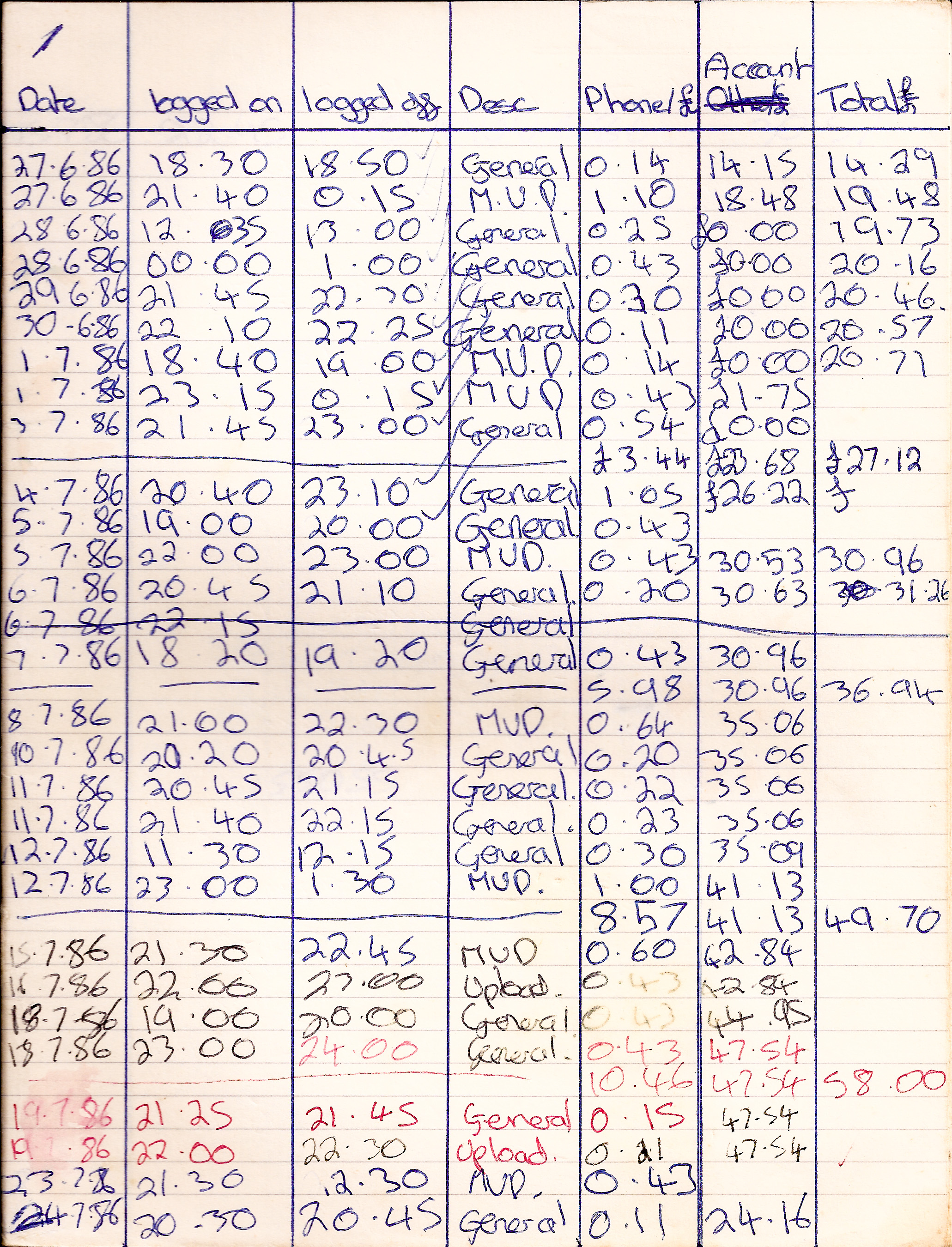
One particular ‘scandal’ revolved around the death of Doommlord the Legend.  Legend status was one level shy of becoming wizard and achieving immortality.  To get to such a level required many hours of play, and at £1.75/hour it was not a minor investment.

The death of a legend was pretty upsetting for the player involved, fortunately I only endured it once.
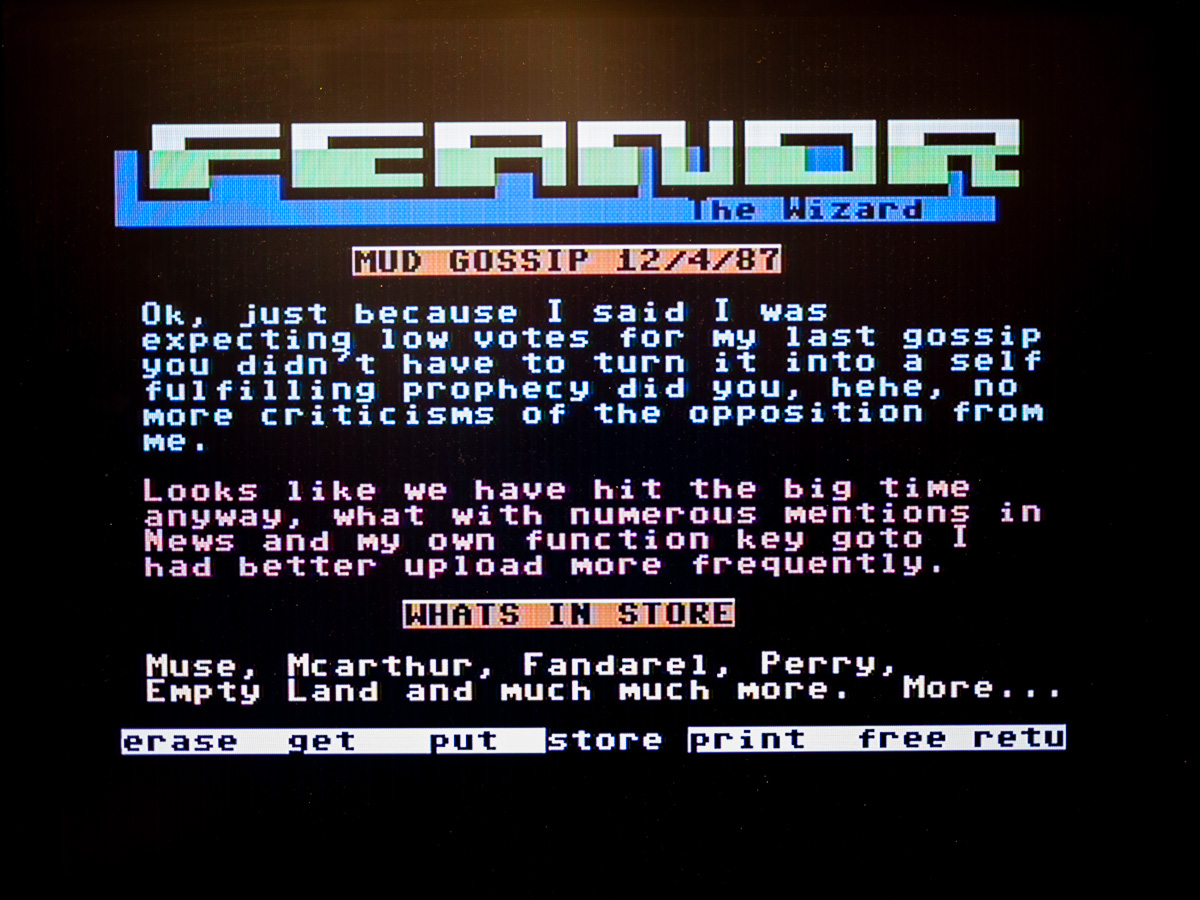
Feanor's Mud Gossip

Feanor’s Mud Gossip

In this case added intrigue was born from the suspicion of foul play.  Doommlord was a murderer, and a very successful one at that, there were many players out for his blood.  I happened to be snooping on Doommlord (you receive their game feed as well as your own) when he met his bloody end.

Weakened by a fight with a strangely powerful skeleton, Doommlord was set upon by two or three other players.  It seems likely that an immortal ‘frigged’ the skeleton.

UCAT

UCAT

This involved changing the statistics of the mobile (in-player character) to make them a lot stronger than usual.

Anyway, to cut a long story short I’ve included a video of the game log below.  I appreciate this will be of limited interest but you never know, an ex-player may chance upon it one day.  Further below I’ve also added a video showing the 64 with the Compunet modem attached and a video of files being loaded into the editor.

Compunet – Log On To The Live One

cnet10

I recently discovered a box of 5.25″ floppy disks which had been in storage since the mid Eighties and wrote about how I’d recovered some data from one of them which turned out to be computer studies project I’d been working on at school in 1985.  That was one disk in a box of ten or twelve others, others which were unlabelled and I assumed blank.

Commodore Modem Settings

Commodore Modem Settings

However whilst recently using my Commodore 128D something, somewhere, deep in my mind prompted me to insert one of the disks into the 1571 drive and type LOAD”$”,8.  When I was subsequently greeted with a LOADING prompt I became quite excited.  Nervously I typed LIST and was greeted by a directory of various files, mostly related to Compunet.

Back in 1983/4 Commodore UK helped initiate Compunet, a UK specific dial-up interactive service hosted originally on a DEC 10. It was with retrospect an astonishingly ground breaking initiative.  An online community where users could create their own areas, upload content and have that content voted on by other users.  Content could even be priced, downloaded and paid for.  There were also popular online games and chat rooms.

Classic Compunet Setup

Classic Compunet Setup

The vast majority of users accessed Compunet with a Commodore 64 and Commodore Communications Modem, the latter of which contained a built-in text and low resolution graphic editor.  These allowed you to create content offline before uploading, thus saving on expensive phone charges.  Latterly the service would also see users logging on with Amigas and even Atari STs.

While some users had cool handles, youngsters such as myself who relied on their parents to set up their accounts ended up with anonymous handles like TBAH1, my Father’s initials. I believe you could pick something more memorable for an additional charge.

The Compunet Server

The Compunet Server

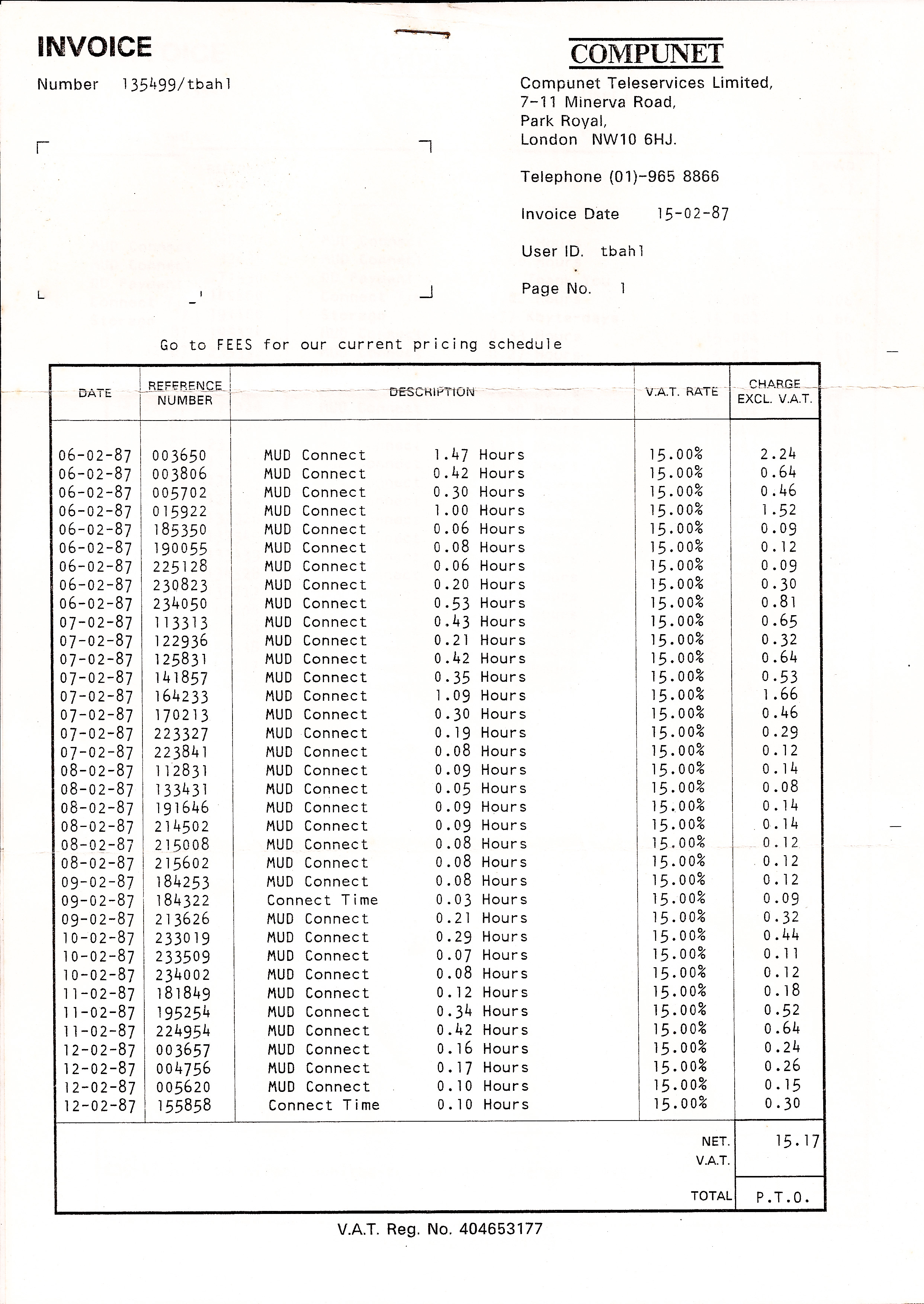
There were originally three subscription choices, Basic, Standard and Gold ranging in price from £7.50 to £15.00 per quarter.  Access to the system was free of charge between 6 pm and 8 am although you still had to factor in your BT phone bill which typically ran at around £0.60 per hour.  Access to online games such as M.U.D. cost an additional £1.75/hour.

As many of the users were like myself teenagers, this led to some interesting family discussions when the phone bill arrived.

My own experience of Compunet consisted largely of creating and uploading artwork as Spock and playing M.U.D. as Feanor for which I created a M.U.D. Gossip page (or the Technicolour Yawn page as my good friend Urbancamo (DEW2) once referred to it!)  After many hours playing M.U.D. at the aforementioned £1.75/hour I reached the penultimate status of Wizard and achieved immortality.

diary

My Compunet Usage Log

The ultimate status was of course reserved for the Arch Wizards, responsible for running and moderating the game.  The two I can remember were Roy and JohnK, the latter of which sent me my Wizard’s Pack which contained amongst other things, full maps of the game which I still have.

Classic 80's Look

Classic 80’s Look

As I worked my way through the floppy disks it was a pleasant surprise to find some remnants of my M.U.D. Gossip page and some old artwork.  The disks were understandably flaky and many files were unreadable.  Frustratingly the artwork I was able to recover was mostly work in progress, however I’ve included some here for nostalgia.

My weapon of choice was Vidcom64 which I bought on Compunet for the princely sum of £4.50.  Initially I was forced to use either the cursor keys or joystick to draw with.  This meant slow progress to say the least.  I eventually cobbled together enough pennies to buy a second-hand Koala Pad which at least allowed a moderate amount of freehand drawing.

Drawn With Vidcom64

Drawn With Vidcom64

After uploading several pictures I was approached to create the artwork for the loading screens of a couple of games.

Unfortunately immaturity and general apathy prevented me from meeting the required deadlines so there ended my career as an 8-bit artist before it had even started.

My M.U.D. Gossip page was quite popular with fellow players.  Once I’d made Wizard I’d log on and monitor an evening’s session, jotting down notes of new players, those who’d achieved a new rank and of course those who’d had been killed.  At the end of the week I would upload a round-up of events for all to read and hopefully vote on.

Compunet Guide

Compunet Guide

I also found a number of demos while working my way through the floppy disks.  The demo scene was a huge part of Compunet and every new release was eagerly anticipated.  Some of the hacks on display were frankly extraordinary,  I’m sure that even the creators of the 64 were astonished by some of the tricks these guys pulled off.  Many of the people involved were head hunted and went on to have careers in the video games industry.

Perhaps inevitably given the inexorable rise of the Internet Compunet ceased trading in 1993.  Somewhat ironically there’s a Facebook group for ex Compunet users. It was here that I learnt the rather depressing fact that some of the original disks and tapes on which Compunet resided were still in existence as late as 2008 at which point they were apparently thrown away.

Work In Progress

Work In Progress

This made me quite angry, not with any particular individual, but with the circumstance.  When you read about the latter-day exploits of Jason Scott and the Archive Team you have to wonder why at no point did anyone in a position to do so stop and think, we really need to try to recover and preserve this stuff.

I have some more files to look at, a number of them are I believe pages I created with the Commodore Modem’s built-in editor, and some are presumably other pages that I’d downloaded.  I did manage to find my original modem, however it doesn’t appear to working correctly so I’m going to try to locate a working model and see what else I can recover.

Old Disk Contents

Searching Old Disks

I’ve pulled together a few resources for those interested in further reading.  There is of course a Wikipedia article which goes in to further detail and there is also Mike Berry’s excellent 64apocalypse site which is as far as I can tell the most comprehensive single online resource covering Compunet.

Richard Bartle, co-creator of M.U.D. has some interesting articles on his site, not least of which is this one.  A good article from the January ’85 edition of Your Commodore can be found here.  You can play M.U.D. here.

There’s a bio of Nick Green here, the main man behind Compunet.  Another interesting article can be found here.  I’ve also scanned in some literature that may be of interest:-

Compunet GuideCompunet GuideCompunet LetterCompunet LetterMud Gossip NotesCommodore Communications Modemcn12Commodore Communications ModemCompunet BillCompunet GuideCompunet GuideCompunet GuideCompunet GuideCompunet GuideCompunet Guide

Commodore 128D, Flyer & Iffy Jiffy

_1040145

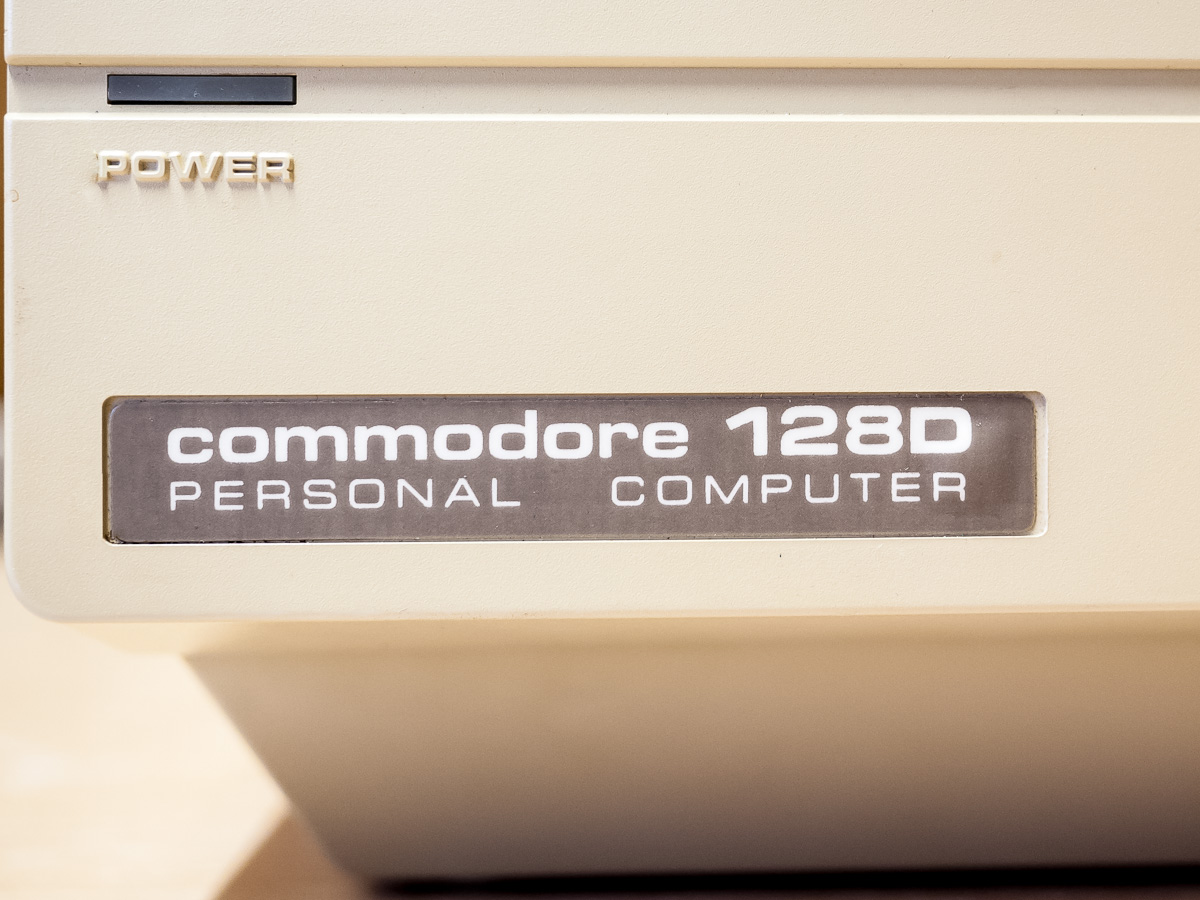
Despite having bought it over a year ago, my Commodore 128D has not found its way onto my workbench as often as I’d intended. There are two specific reasons for this, the built in 1571 disk drive is temperamental to say the least and the fan that cools the machine’s power supply is not only noisy but cursed with a tedious whine.

Commodore Flyer

Commodore Flyer

Using the 128D therefore has been an exercise in irritation and frustration when it should be an enjoyable experience given the unit’s multiple computing personalities, a Commodore 128, 64 and CP/M capable machine all rolled into one.

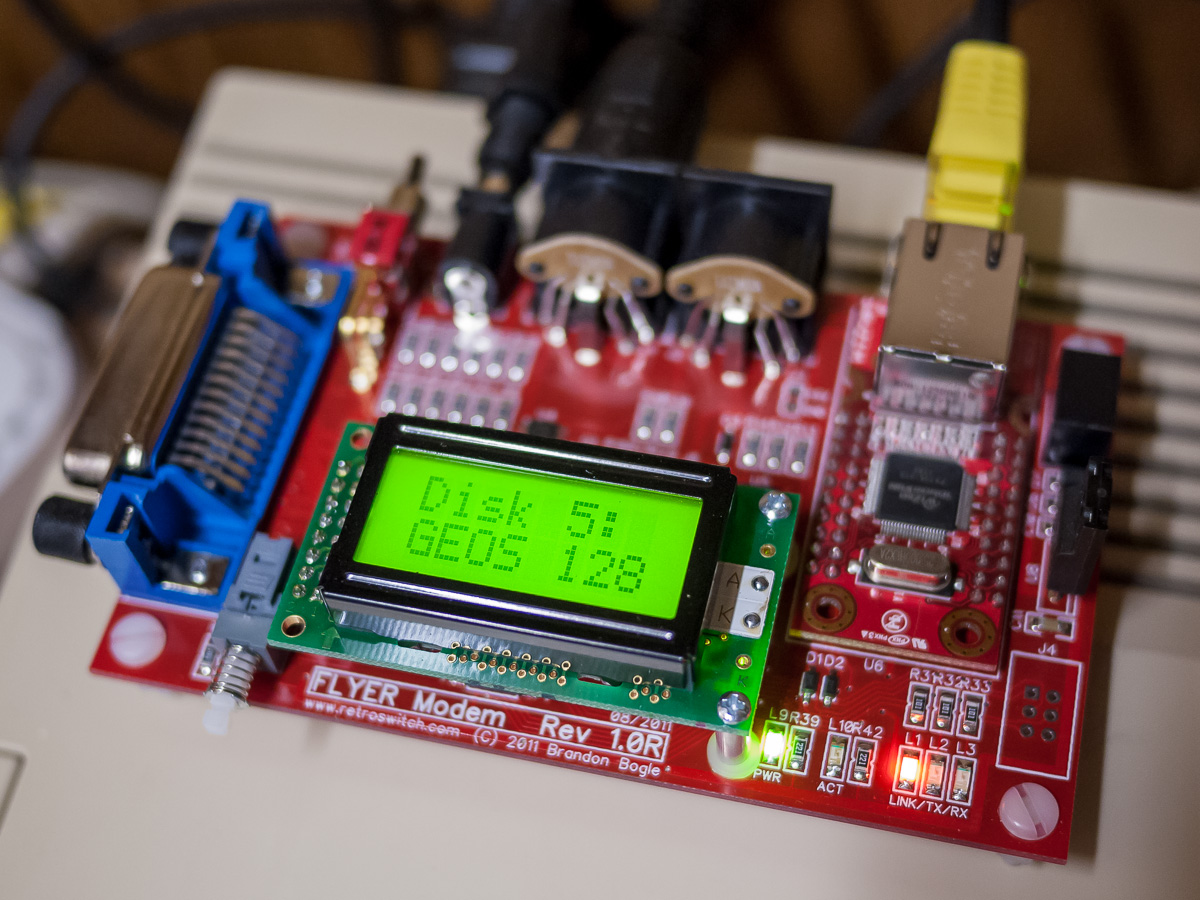
I then became aware of the Commodore Flyer.  This superb piece of kit acts as an internet modem and disk drive emulator, thus allowing me to forget about the flaky 1571 and transfer software into the 128D at my heart’s content.

I ordered a Flyer  from Retroswitch and it arrived promptly from the States.  It’s a really nicely engineered solution and I was quickly up and running, updating the firmware and pulling down disk images from the Commodore Online cloud service that I’d previously set up.

Flyer Telnet Client

Flyer Telnet Client

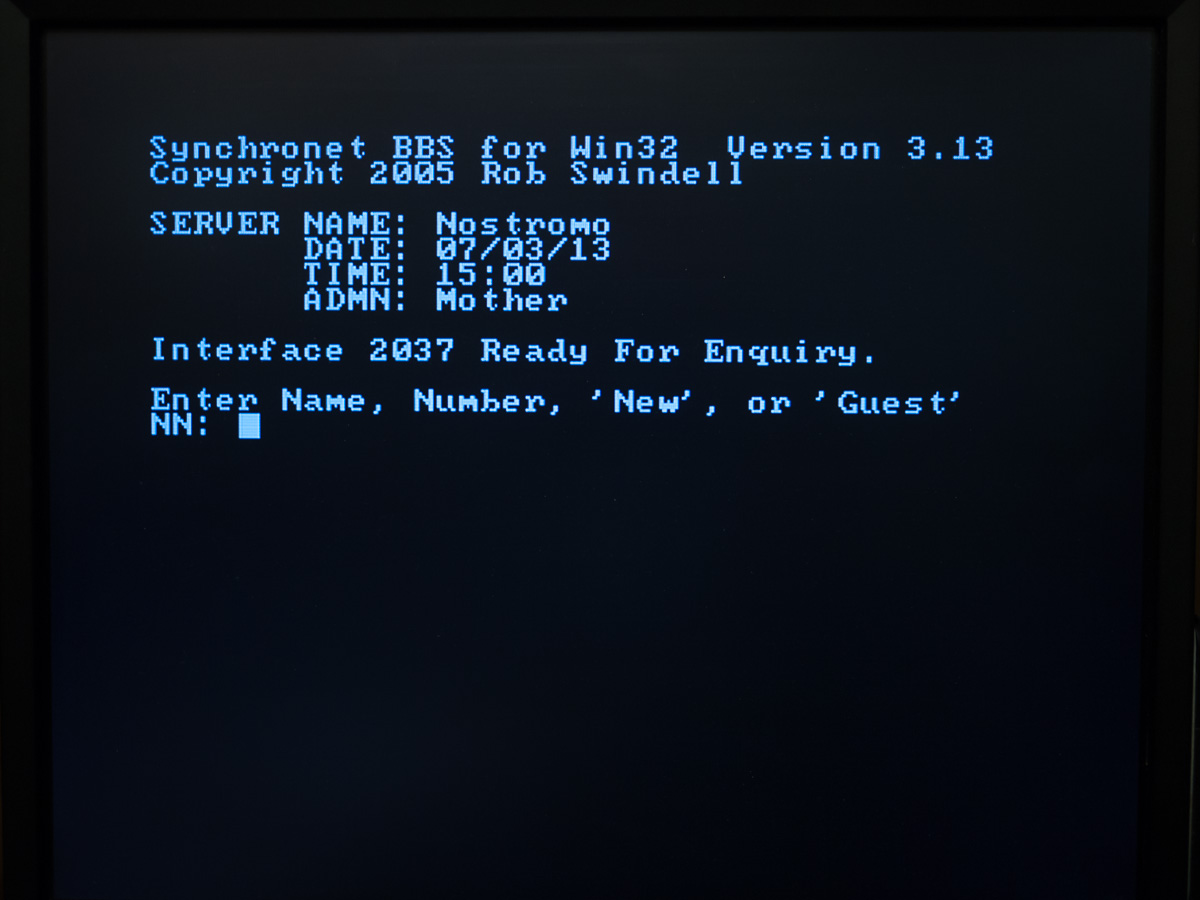
The guys over at Retroswitch have also written a Telnet client which works with the Flyer, although it will only run on a C64 or 128 in C64 mode.  I loaded this up and pointed it at my BBS.  It’s a little rough around the edges but it worked well enough for me to log in and check my mail, pretty cool with a C64!

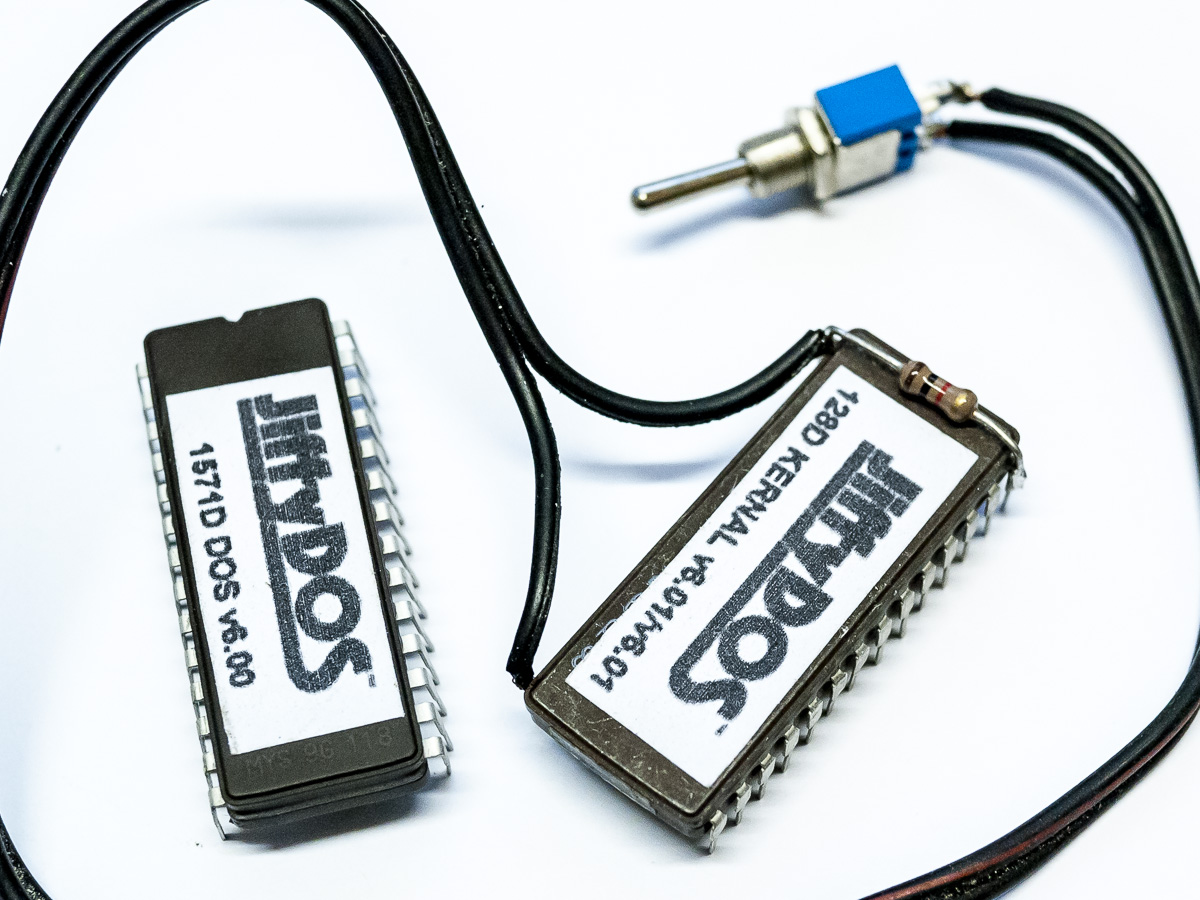
As the Flyer is JiffyDOS compatible and the standard Commodore serial transfer rate is so woefully slow I decided to order a JiffyDOS upgrade kit for the C128D.  On arrival this consisted of two chips, one to replace the kernel on the main board and one for the 1571 drive.

Once the kit had arrived I headed over to Jim Brain’s site and downloaded the installation instructions for the C128D.  However it soon became apparent these instructions were meant for the C128DCR (cost reduced) model which differs considerably from the C128D internally.

JiffyDOS Kit

JiffyDOS Kit

I hunted around but couldn’t find installation instructions for my machine so I decided to trust my instincts and see if I could locate the relevant chips myself.

The drive chip was pretty obvious, being the only socketed chip of the correct size on the drive’s daughter card.  Mine was labelled as a 310654-03.  I gently prized it out with a flathead screwdriver and popped in the replacement.

I then discovered what I presumed was the 128’s Kernel chip, labelled as a 318020-03.  Again I replaced the original chip with the new replacement, reassembled the case and powered on.

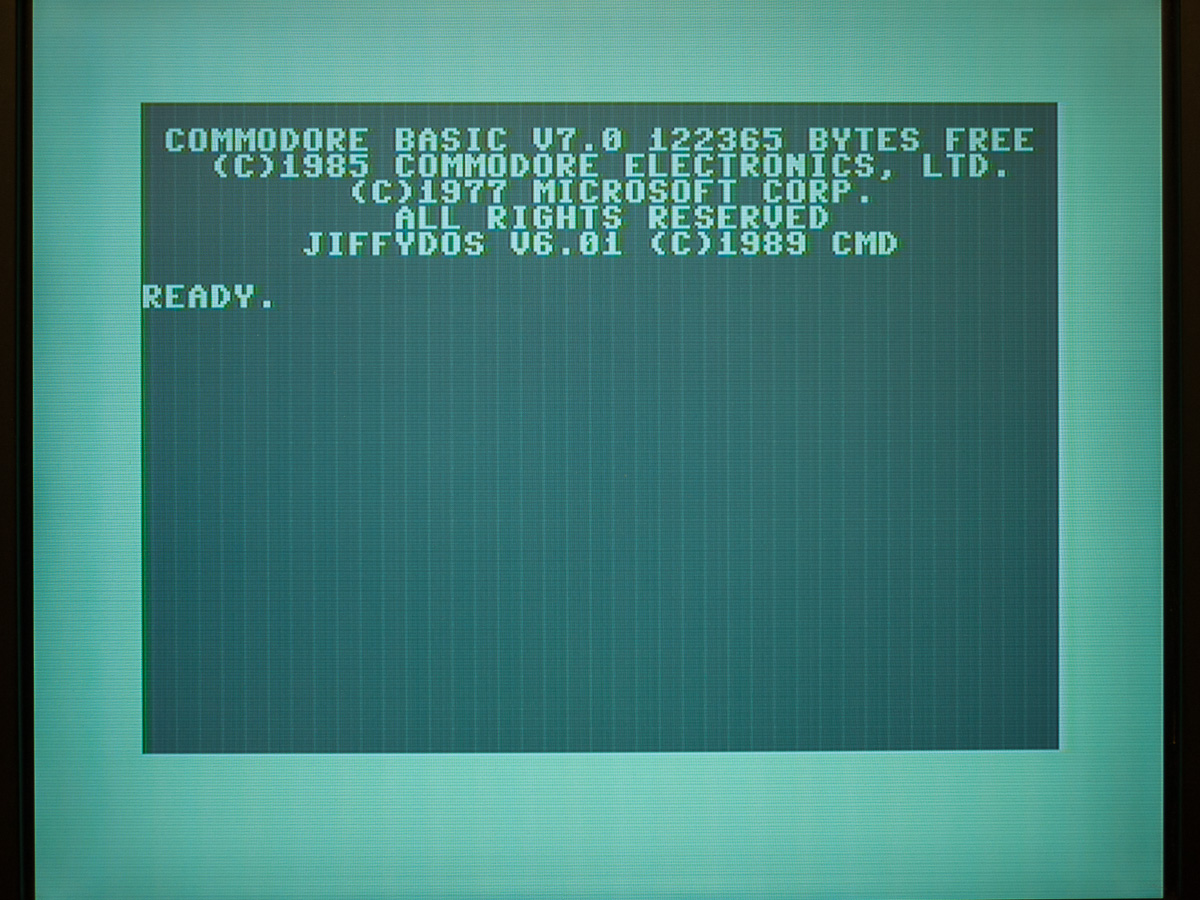
JiffyDOS On The 128D

JiffyDOS On The 128D

The first thing I noticed was that the 1571 was not springing in to life as it usually does on boot.  However the 128 screen came up and there indeed JiffyDOS V6.01 (C) 1989 CMD was displayed.  However there was no flashing cursor.  I decided to completely disconnect the internal 1571 and try again.  This time everything appeared to be working fine.  A quick test using the Flyer to download a program from the cloud server saw an increase in speed from 45 to under 8 seconds, very nice.

I decided to replace the original drive chip and try again with the 1571 reconnected.  Again, no cursor without a Runstop/Restore and even then no joy with either the Flyer or the 1571.  Incidentally the C64 mode was working, but with no JiffyDOS support.

Concerned that in my haste I’d installed the chips in the wrong sockets I headed over to the excellent Lemon64 forum.  There I learnt from the always helpful and knowledgeable members that the 128D requires the same set of chips as the plain C128.  The chips I had were intended for the C128 DCR which is unfortunately also known as the 128D in America, despite being very different from the real European 128D.  As with the C128 the 128D requires replacement chips for both the 128 & 64 Kernel, I believe these are combined on the 128DCR.  Fortunately the original vendor has agreed to send me the correct chips at no extra charge.

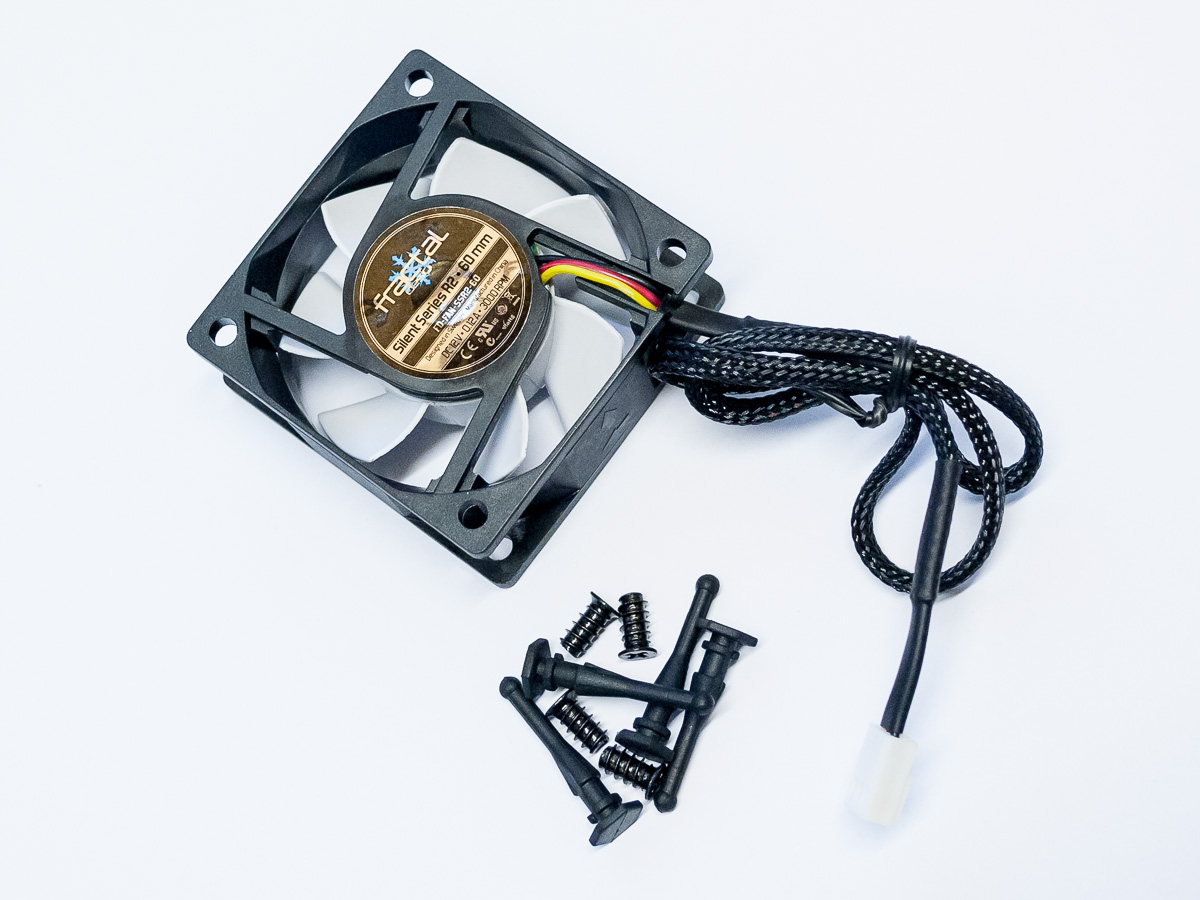
Replacement Fan

Replacement Fan

Somewhat disheartened for now I removed the JiffyDOS chips and replaced the originals.  As if that wasn’t irritating enough, when I rebooted the machine I was greeted with a black screen in 128 mode.

I consulted R Carlsen’s excellent document on common c128 faults and decided to swap the 6526’s in the U1 and U4 sockets.  However on closer inspection it looks to me as though a previous poor repair to the U4 socket was a possible cause and it looked unlikely I’d be able to remove the chip without causing further damage.  There’s melting to the actual socket, presumably from a soldering iron and some less than expert soldering to the board.  I’m guessing that all that levering out and replacing of chips in the nearby U35 socket has damaged what was already a rather tenuous repair.

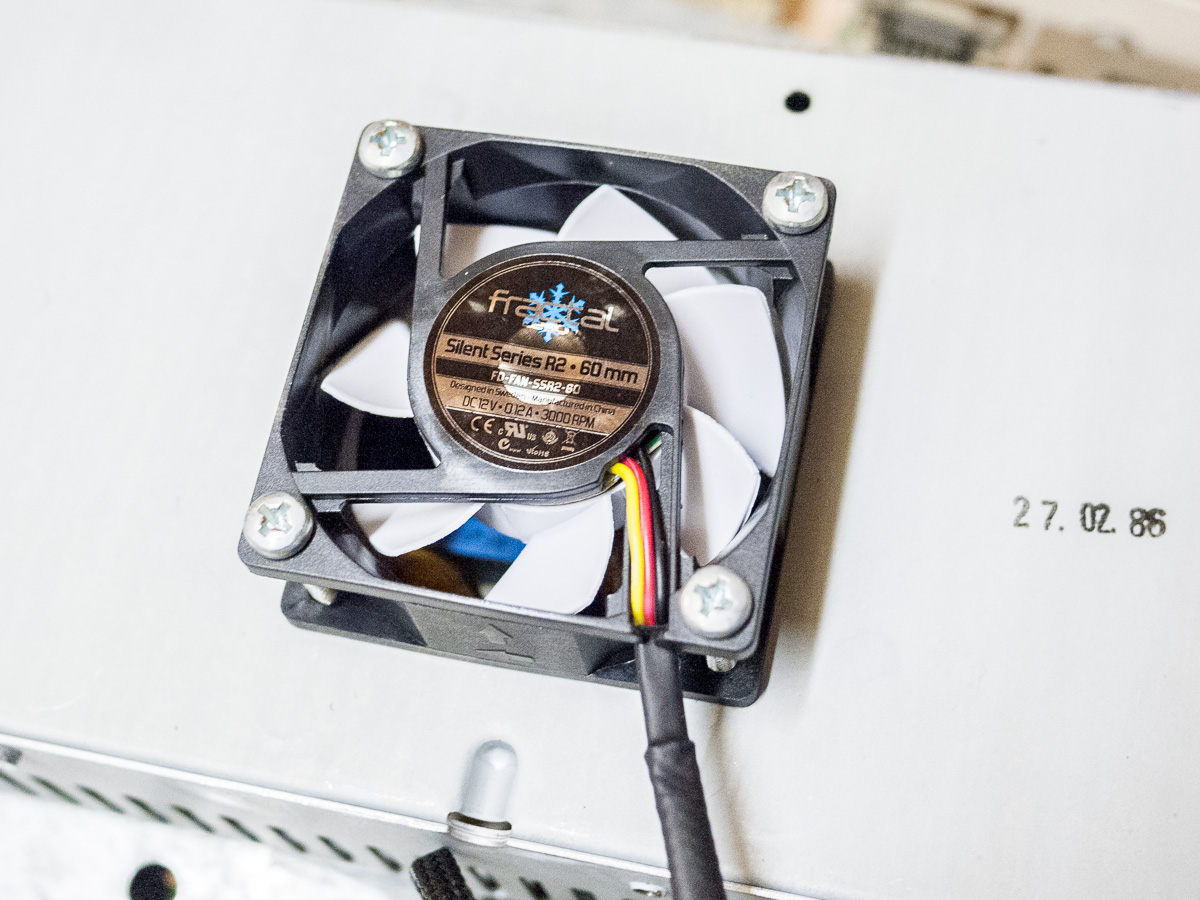
New Fan Installed

New Fan Installed

While I had the case apart I took the opportunity to address the other issue with the 128D, the deeply irritating fan noise.  I found a replacement fan that purported to be silent and quickly replaced the original, which is mounted on the underside of the power supply.  On restarting the reassembled machine there was a considerable improvement.  Silent no, considerable quieter and less whiny, definitely.

So for now I have what is essentially a rather bulky Commodore 64.  I may attempt a repair, although I do have a flat C128, which rather ironically doesn’t work in C64 mode.

Still a Commodore 64 was exactly what I needed as I’d recently found a box of old Commodore 64 floppy disks in the loft…