Madame Fifi’s Whorehouse And Other Tales

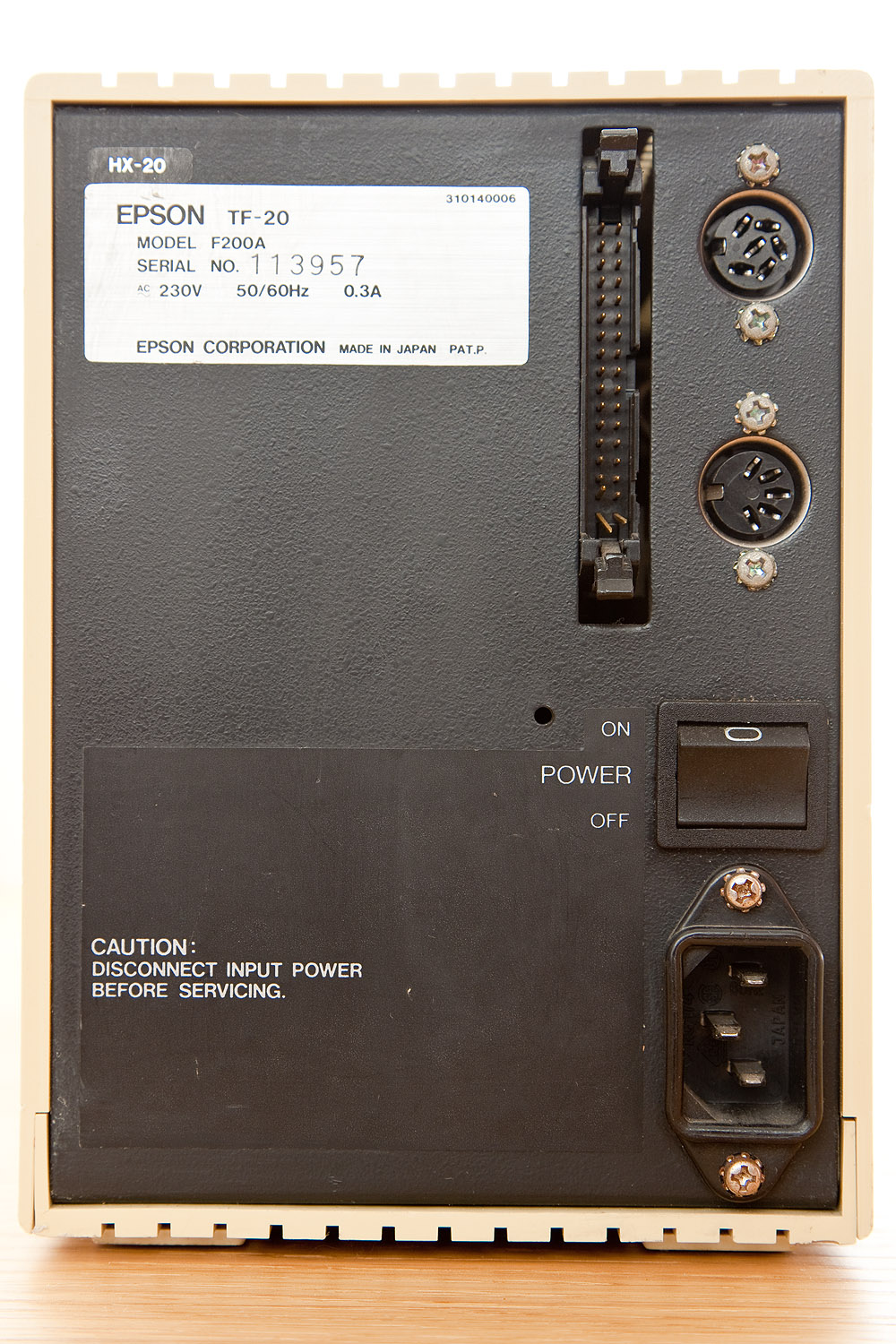
I continue to tinker with my growing collection of old Epson computer equipment.  The TF-20 is a strange hulk of a drive. Rather like the old Commodore 1541 the drive has a processor of its own comparable to the computer it serves.

In the case of the TF-20, a Z80 supported by 64 kByte of RAM (presumably these things cost serious money back in the day.) In order for the drive to work with systems such as the PX-8 you must first load the drive’s OS from a system disk.  This is causing me some concern as I only have one disk that will boot the system and if that fails the drive will be essentially useless to me.

Along with the drive came a few 5.25 inch floppies with an eclectic mix of files on them.  Two that caught my eye were Diskcopy and Copydisk.  My first inclination was to try and make a couple of backups of the boot disk.

I thought I’d found what I needed with Copydisk which gave the following options:-

  • Format
  • Copy System Tracks
  • Copy Complete Diskette
  • Format and Copy System Tracks
  • Format and Copy Complete Diskette
  • Initialize Directory Tracks

After placing a write protect sticker over the notch of the boot disk (this reminded me of using scissors to cut out notches on the opposite side of disks so you could use both sides) I pretty much tried every combination of these options with some new blank disks I’d managed to find on ebay.

Whilst the formatting and copying all worked well, none of the newly created disks would boot the system so for now I’m relying on the squeeky old boot disk.  The OS will remain in memory as long as you don’t disconnect the power cord from the TF-20 however the onboard power adapter gives off the sort of aroma that makes you want to stick a smoke detector directly over it so I’m not relaxed about leaving the power connected.

I’ve also been sorting through the fairly large collection of PX-8 related files I’ve downloaded and have transferred a few basic games via Filink directly onto floppy.   There’s a certain buzz from loading these files with no real idea what you’re going to be presented with.  I think the most surprising so far was FIF which turned out to be Madame Fifi’s Whorehouse, a somewhat lewd text adventure game.

A lot of the files have extensions such as CQM, DQC, BQS which I initially thought had perhaps become corrupted given their similarity to COM, DOC, BAS however on investigation it transpires these are files compressed with a program called SQ which replaces the middle character of all the files it archives with a Q.  So far I’ve been unable to find a way of opening these archives.

(Update)

Thanks to Chuck over at the Vintage Computer Forum who pointed me in the direction of the source files and executable of Unsqueeze at the Retroarchive and to the DOS version
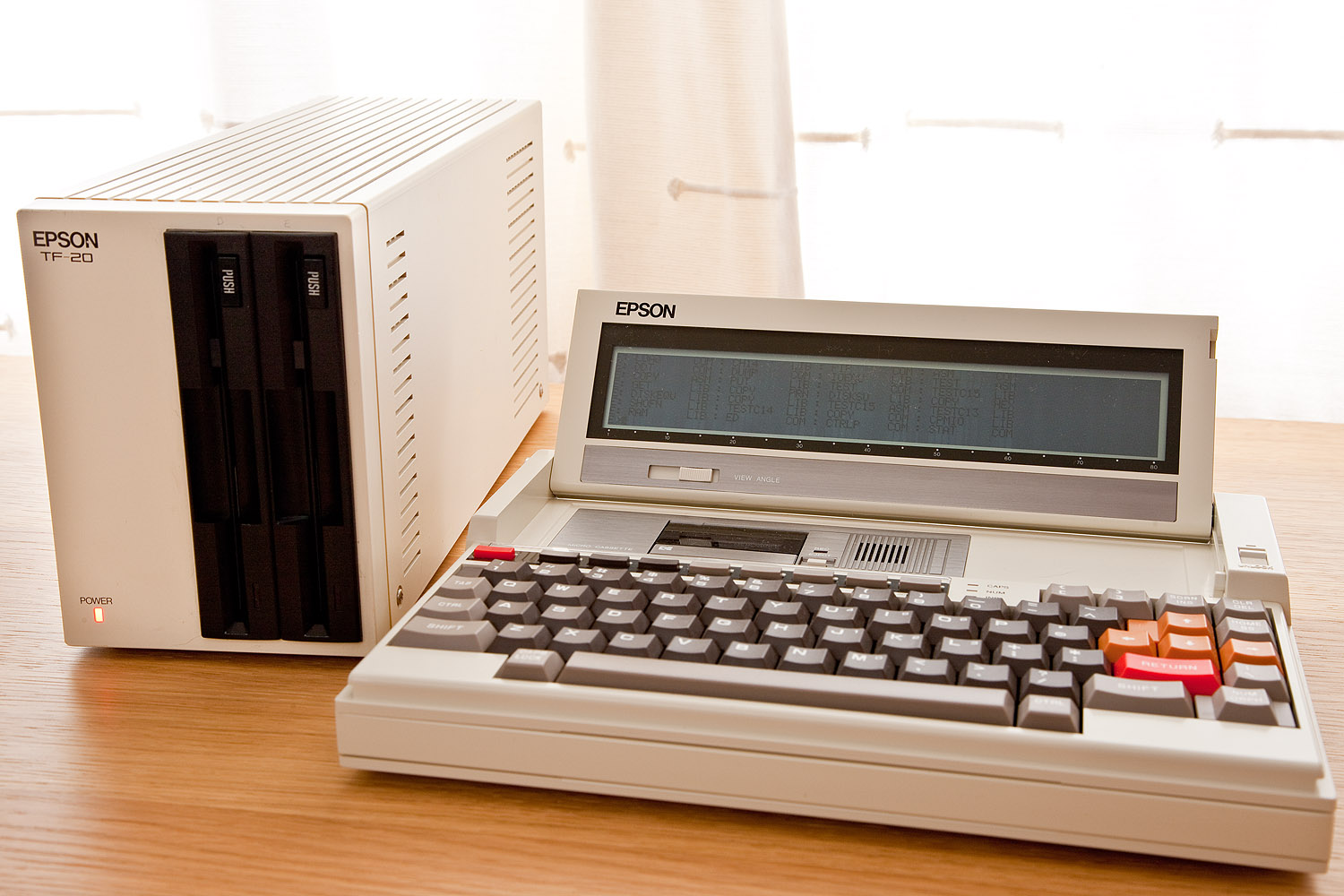
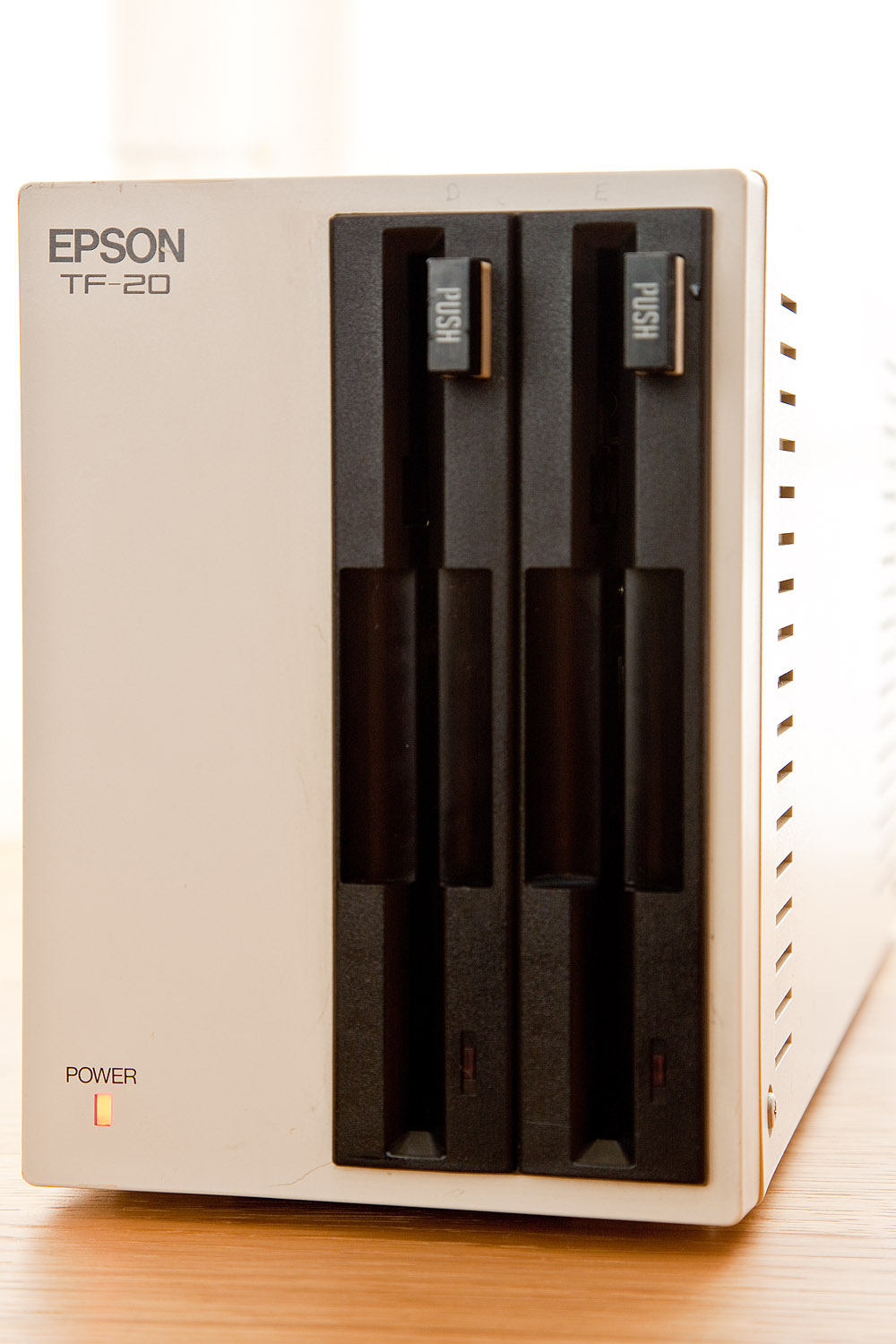
Epson TF-20 5.25 Inch Double Floppy Disk Drive Pictures

As yet no joy with the PF-10, the unit spins up but I’m getting bad sector errors on all the disks I try to access.  I’m not particularly surprised, in fact I would have been more surprised if it had worked.  However I shall try and clean the heads and have a poke around to make sure everything that should be moving freely is doing so.

More luck with the TF-20 which is in fine working order.  Both bays are working well and I’ve managed some read and write operations on both.  The unit itself in monstrously heavy, most of the weight is I assume coming from the built in transformer.  So far I’ve tried the unit with a PX-8 and PX-4.  Along with the PF-10 the TF-20 came with a huge bundle of PX-4 related items.  The PX-4 itself, several spare keyboards, a couple of cassette units, a ram disk and a rom holder all of which are interchangeable on the PX-4 (also apparently known as the Epson Pine.)

I also have some promotional literature for the PX-4 and an original UK price list which I’ll scan in and post.  For now some pictures of the TF-20.

Epson PX-8 Geneva Filink Success

This weekend I was very grateful to Urbancamo who as promised built me a suitable cable to connect my PX-8 to my DOS box.  To connect the RS232C port on the PX-8 to a PC Com port I needed a male 8 pin mini din to female DB9 connector.  I found an open ended 8 pin mini din cable on Ebay and Urbancamo kindly added the required female DB9 connector wired with the following configuration.

Having trawled through a load of old machines that were piled up at work, most butchered for parts I found one venerable Fujitsu, Pentium based machine running Windows 95.  Apart from a system fan that sounds like it’s rubbing up against a cheese grater it’s in good working order.  Most importantly it had a suitable Com port and a working CD drive.

I grabbed a load of PX-8 files from F J Kraan’s excellent PX-8 resource and transferred them by CD to the Fujitsu.  I cleared up the autoexec.bat file and added a line to set the Com port’s parameters to match the PX-8’s (Mode COM1:4800,N,8,2,P) with the knowledge that Filink seems to find any excuse to hang and that several reboots were probably on the cards.

Once the two machines were connected I loaded up Filink on both and set about transferring some files.  Oddly the transfer would begin and then Filink would attempt to access the floppy drive on the DOS box (which had no disk in it as I’d booted from the hard drive and not used the floppy for anything) causing the transfer to fail.

I dug out an old floppy disk put it in the drive, it was formatted but empty and tried again.  This time the transfer worked with the floppy drive access light flashing momentarily.  Quite what difference having a blank disk in the drive made I’ve no idea but Filink won’t work without it there, weird!

Now I have a working method of transferring files and, excitingly (if you like that sort of thing) I found a PF-10 on Ebay and it should be here within the week.  Fingers crossed it works.