Guybrush Threepwood in CGA

No progress on the Silent Running adventure for a couple of days.  I got bogged down in trying to resolve a particular issue, realised it was time to walk away and come back fresh which hopefully I’ll do today or tomorrow.

Instead I’ve been messing around with the Equity, trying to understand what it’s capable of.  My first experience with a PC as opposed to machines such as the Amiga and Commodore 64 was a Pentium 90 based machine with Windows 3.1, so the pre Pentium days passed me by.

I’ve been trying to compile the code I have written so far with the Equity with no luck as yet.  As a point of interest the code compiles on a Core 2 Quad essentially instantaneously.  On a Pentium 166 it takes a few seconds.  On the Equity it’s taking around 4 minutes before failing on a specific library issue.  I need to try the Minform library I mentioned in an earlier post next.

I also wanted to see what games would run on the Equity and found an early version of a Secret of Monkey Island demo which loads and runs.  I was never really aware of the limited graphics abilities of the early PC’s having been spoilt by the abilities of the Amiga and its custom chips, it’s pretty basic stuff as I’m discovering.

The Equity has two option slots, one is currently occupied by the hard drive controller card and I believe the only other card produced specifically for the option slots by Epson was a modem card.  Somewhat bizarrely one just came up on Ebay, unused, and new in the box so I snapped that up (only bidder) and it’s on its way.

Monkey Island Demo

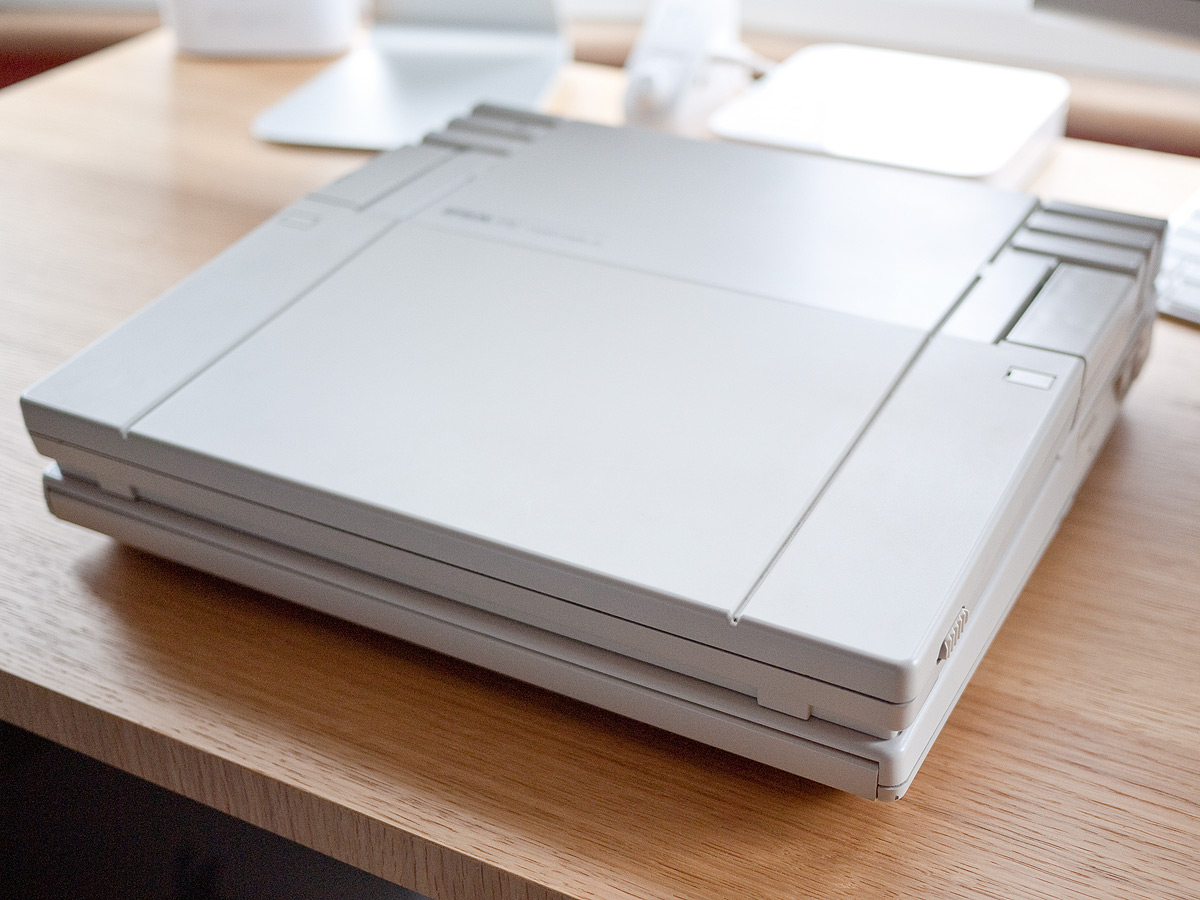
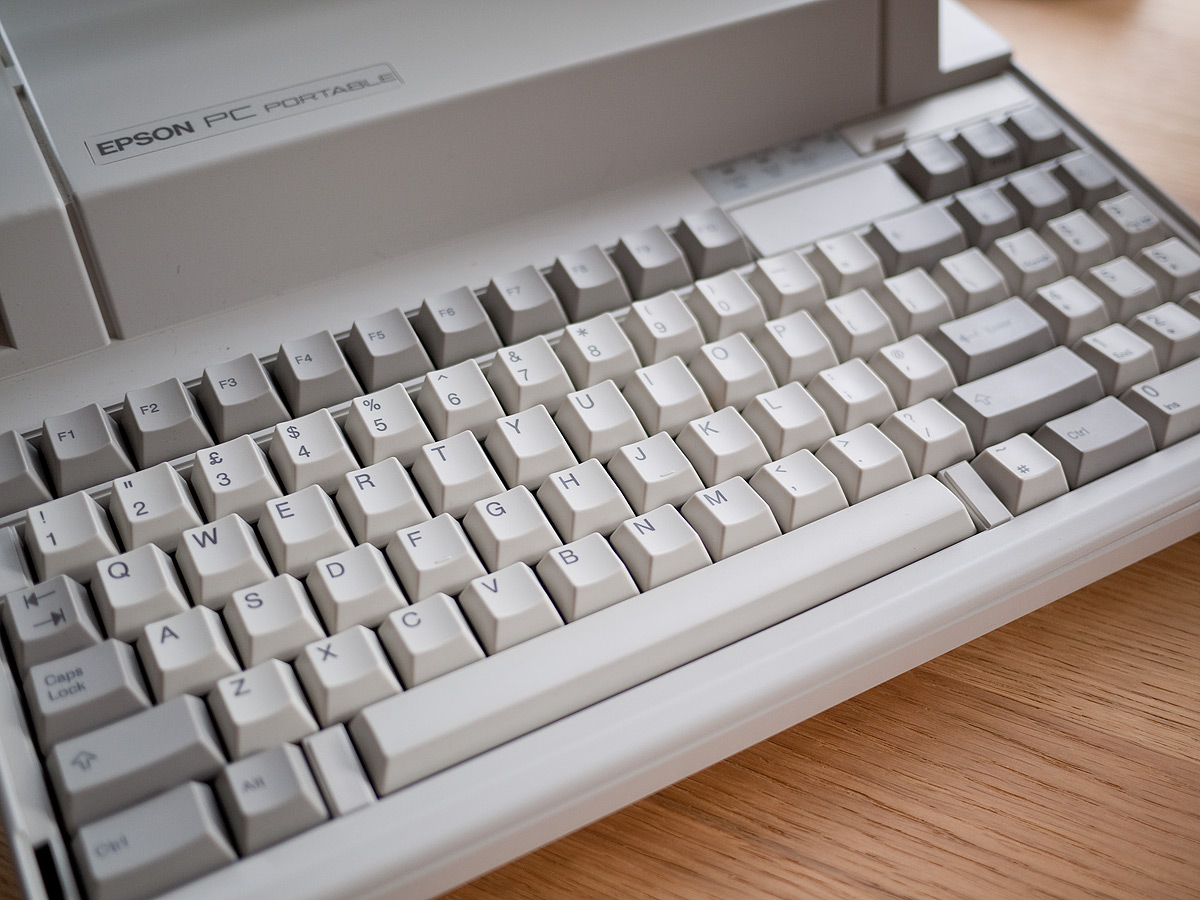
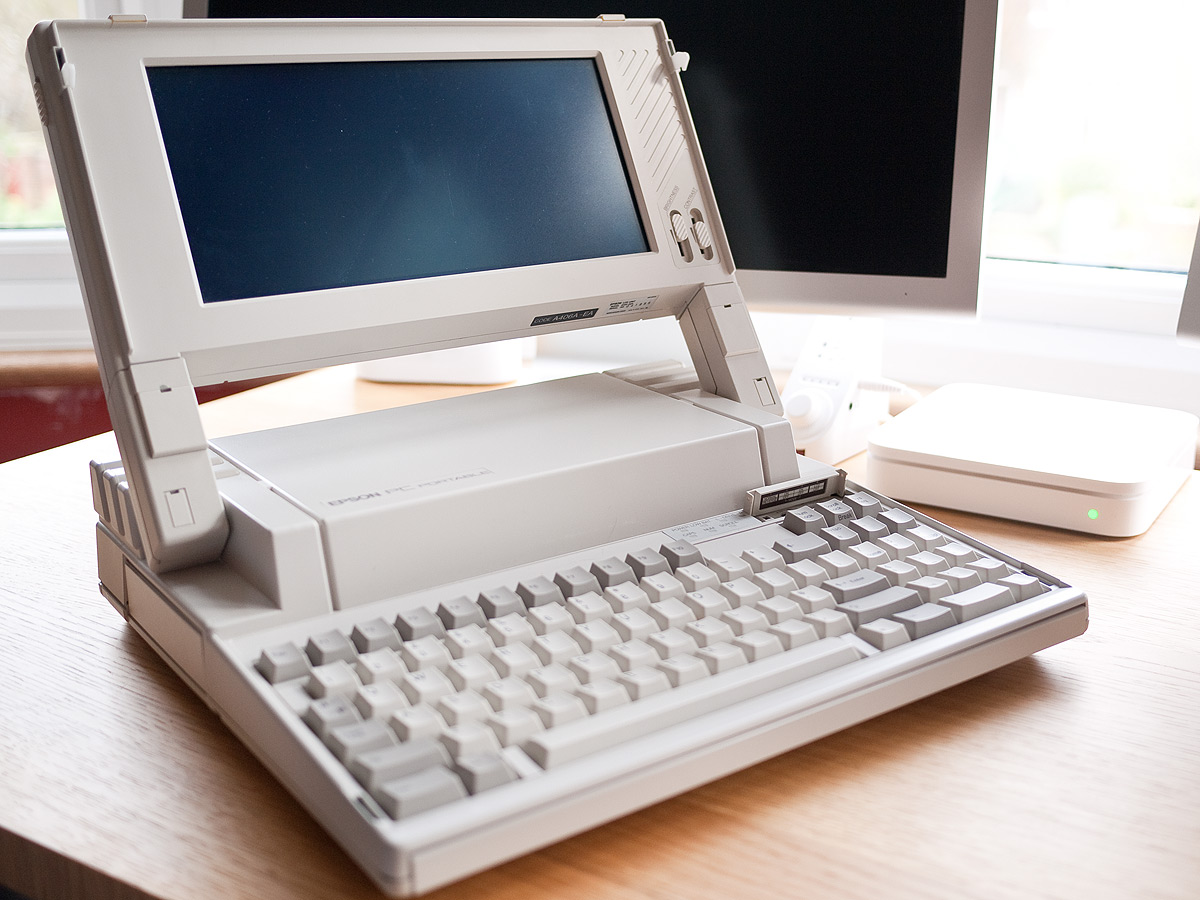
Epson Equity LT

I’ve been trying to settle on one platform for the development of my Retrochallenge Winter Warmup project, a text adventure for my (and other) CP/M based Epson PX-8.  Not that long ago I acquired an Epson Equity LT laptop circa 1989.

The unit itself is in remarkable condition cosmetically and runs quite happily when booted into DOS using the internal 3.5″ floppy drive.  However when originally attempting to format the internal hard drive the format would progress normally to about cylinder 158 or so whereupon it would slow to a snail’s pace taking roughly 20 minutes per cylinder from there on.

Given that I don’t really need 20MB of disk space for my project I got the unit out again and used fdisk to create a DOS partition that only used the first 156 cylinders or around 4-5 MB of the drive.  The format progressed successfully and I installed MS DOS 3.2 from the original Epson disk that came with the unit.

I have a fondness for Epson design from this era and I think it’s a great looking unit.  The screen is pretty good and I like the keyboard.  The main specifications are:-

CPU – NEC V30 (μPD70116) CMOS microprocessor, compatible with Intel 8086 runing at the same speed as the 8086 but 10% – 30% faster. (DIP switch on front on unit allows switching between 4.77 & 10mhz speed)

RAM – 640k

Floppy Drive – μPD765A controller supporting four 360Kbyte or 720Kbyte 3.5″ disks.

Hard Disk – JVC JD-3824R RLL type, 21.44 Mbytes 95mm diam.

Option Slots – Two 8bit expansion slots (Modem on the way from US)

Graphics – Built in LCD and RGB output for external monitor CGA standard up to 8 grey levels.

Epson Equity LTEpson Equity LTEpson Equity LTEpson Equity LTEpson Equity LTEpson Equity LTEpson Equity LTEpson Equity LTEpson Equity LTEpson Equity LTEpson Equity LTEpson Equity LT

Retrochallenge Progress Update

Er, well, slow.

Verbose Mode (On)

Taking two factors, one, I haven’t done any form of coding for several years, two, I was never any good at it in the first place, and the result is a slow and somewhat laborious process.  I am however still enjoying it, although some of the more masochistic ideas I had such as using the Atari Portfolio to write some of the code did rather stretch the definition of enjoyment.

I find the puzzles and solutions come quite easily and I can loosely imagine how to implement them into code but then I just seem to get bogged down in syntax issues and other problems.  What I need is to combine my creative genius (ahem) with the god like coding abilities of someone like Urbancamo (this of course was always the master plan during our formative years, then we chose the path of least resistance instead.)

As I mentioned before the Infocom interpreter I have for CP/M is limiting me to version 3 story files and I’m therefore using Inform 5.5 v1502 to compile the game as this is one of the last releases to support that version of story file.  Using the standard Inform 5 library files a two room game with a couple of objects is coming out at about 42K.  Increasing to 48K for about 12 rooms with 20 or so objects.  I shall try the Minform library I mentioned in my previous post and report back how much this shrinks the file size but I need first to understand what exactly has been stripped out.

In the interests of pulling this thing firmly back into Retrochallenge territory I’ve been looking at concentrating on one (retro) development platform.  To date development has taken place on several machines including Mac, PC and retro.

I’m therefore going to make another attempt to resurrect a 286 based Epson Equity LT machine that I acquired a while ago and use that from now on.  I’ll try and document that process shortly.

In the meantime I’ll take this opportunity to give a shout out for some resources that I’ve found very helpful whilst grappling with Inform.

Doe’s Inform Primer (Has proven to be very useful, well worth a look if you’re new to Inform.)

Roger Firth’s IF pages (Again, a great help.)

Interactive Fiction Forum (Friendly, helpful forum, covers many aspects of IF.)

Inform Designers Manual (A prerequisite.)