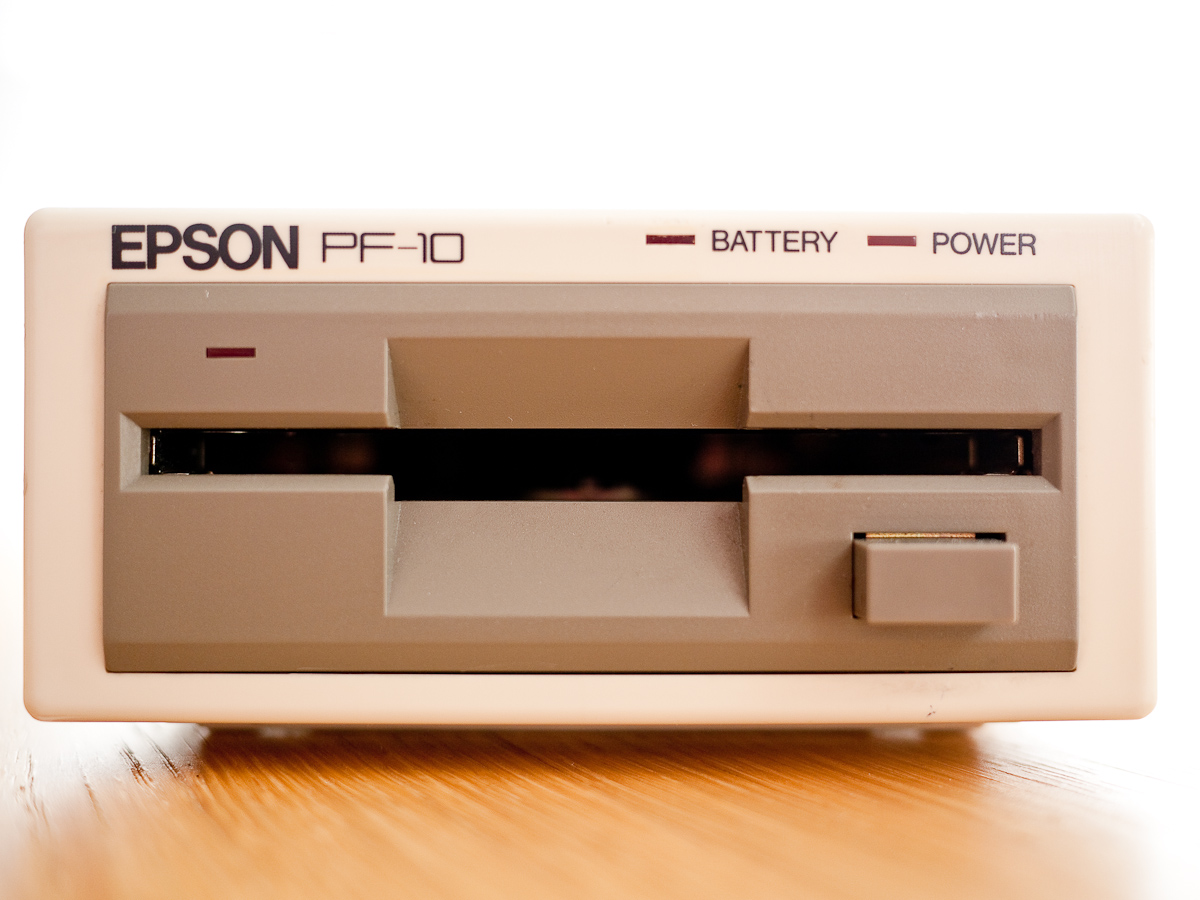
I have a couple of Epson PF-10 portable 3.5″ floppy drive units. One is in very nice cosmetic condition, the other is pretty battered. When I initially received them, the battered unit seemed to hold a charge and would spin a disk but never successfully read or write to one. The other unit worked for a short while, albeit intermittently before completely dying on me.
The PF-10 is an odd beast, taking standard DSDD 3.5″ disks it uses the same 40 track format as the TF-20 5.25″ drive resulting in a formatted disk capacity of 278k. I don’t know how common battery operated portable floppy drives were but the PF-10 is not unique, a quick search turned up this HP Drive and this drive for the Tandy TRS-80 and I’m sure I once read about a unit for the Cambridge Z88 though I can’t find reference to it.
The PF-10 has a replaceable main NiCad battery which can also be substituted for four dry C cells. In order to prevent the drive dying in the middle of operation when the battery runs low there’s an additonal sub-battery hardwired inside the unit, a single 4.8v 100 mAh cell. A battery light on the front of the unit lights when the main battery is low to warn you that the sub battery has kicked in and will subsequently flash when the sub battery itself is running low.
I read sometime ago in the manual that when using dry cells in the unit it may still not work if the sub battery is flat and this is what I found leading me to conclude that the sub battery was dead as I’d made numerous attempts to charge it, no surprise really after 25 years or so. Putting a meter on the battery confirmed this.
I had envisaged trying to replace the sub battery but my soldering skills are poor and these drives are pretty rare, I don’t want to be responsible for totally wrecking one. I dug out the battered unit and took it apart thinking I might be able to clean and align the heads on it. However putting a meter on the sub battery on this unit showed some life in the old cell.
I therefore decided to take both units apart and swap the boards so that the board with the working sub battery would be combined with the drive that had worked in the past. I then swapped out the original Epson main battery and replaced it with a modern NiMh pack. On connecting up the drive to the PX-8 things initially looked promising as I was able to read the directory of a disk, however the sub-battery light then immediately came on and shortly after began flashing, then the drive died.
I knew the NiMh pack had a good charge and a meter appeared to show the sub-battery also holding a reasonable charge. When I plug in the AC adapter the unit works fine which it didn’t do before but at the moment I can’t understand why the unit won’t run off of its batteries and the manual does advise that you shouldn’t run the drive with the adapter attached.
So some success, I can use the drive albeit with the adapter attached.



 Retrocosm's Vintage Computing, Tech & Music Blog