Archive
Epson PX-8 Geneva Pictures
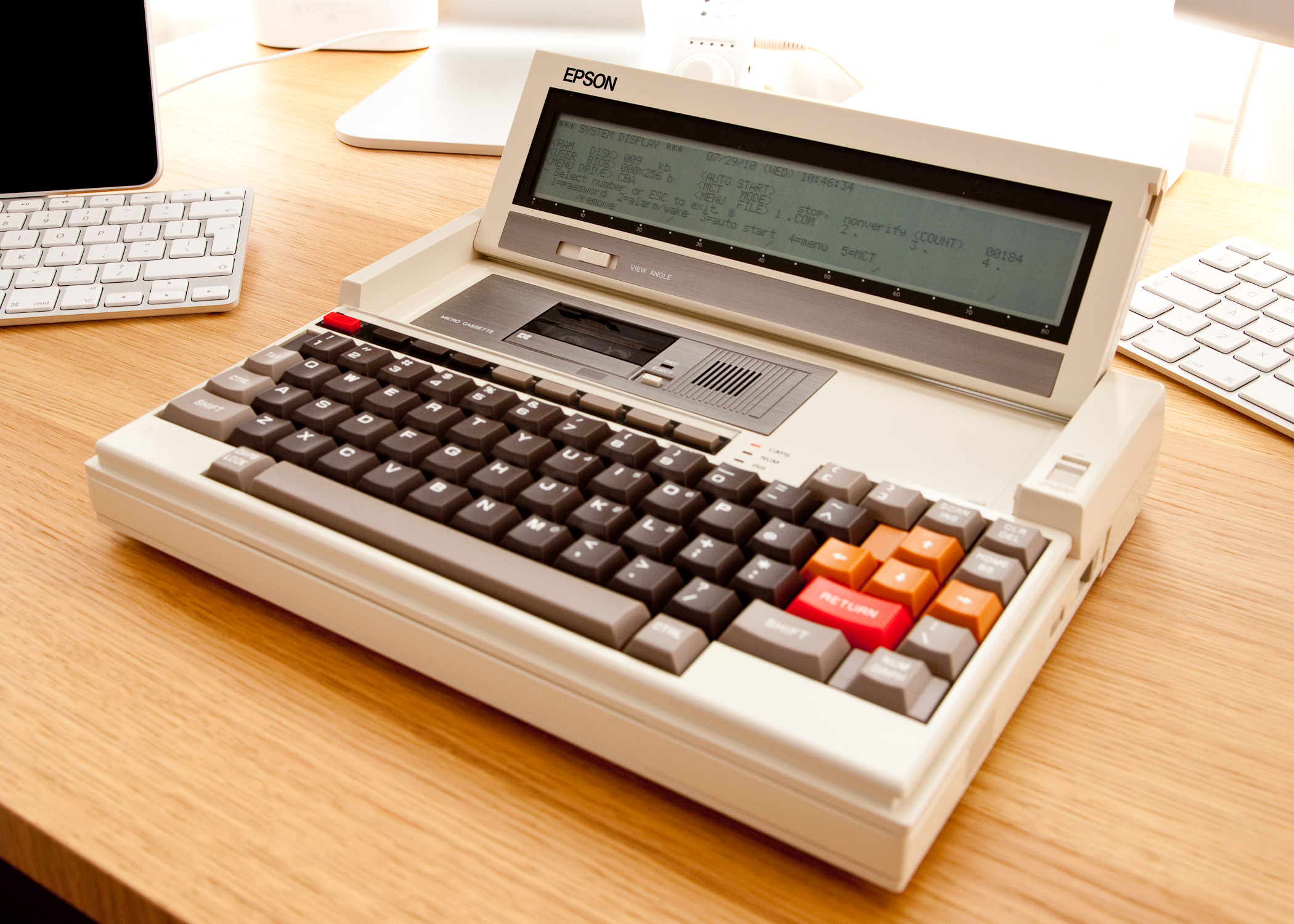
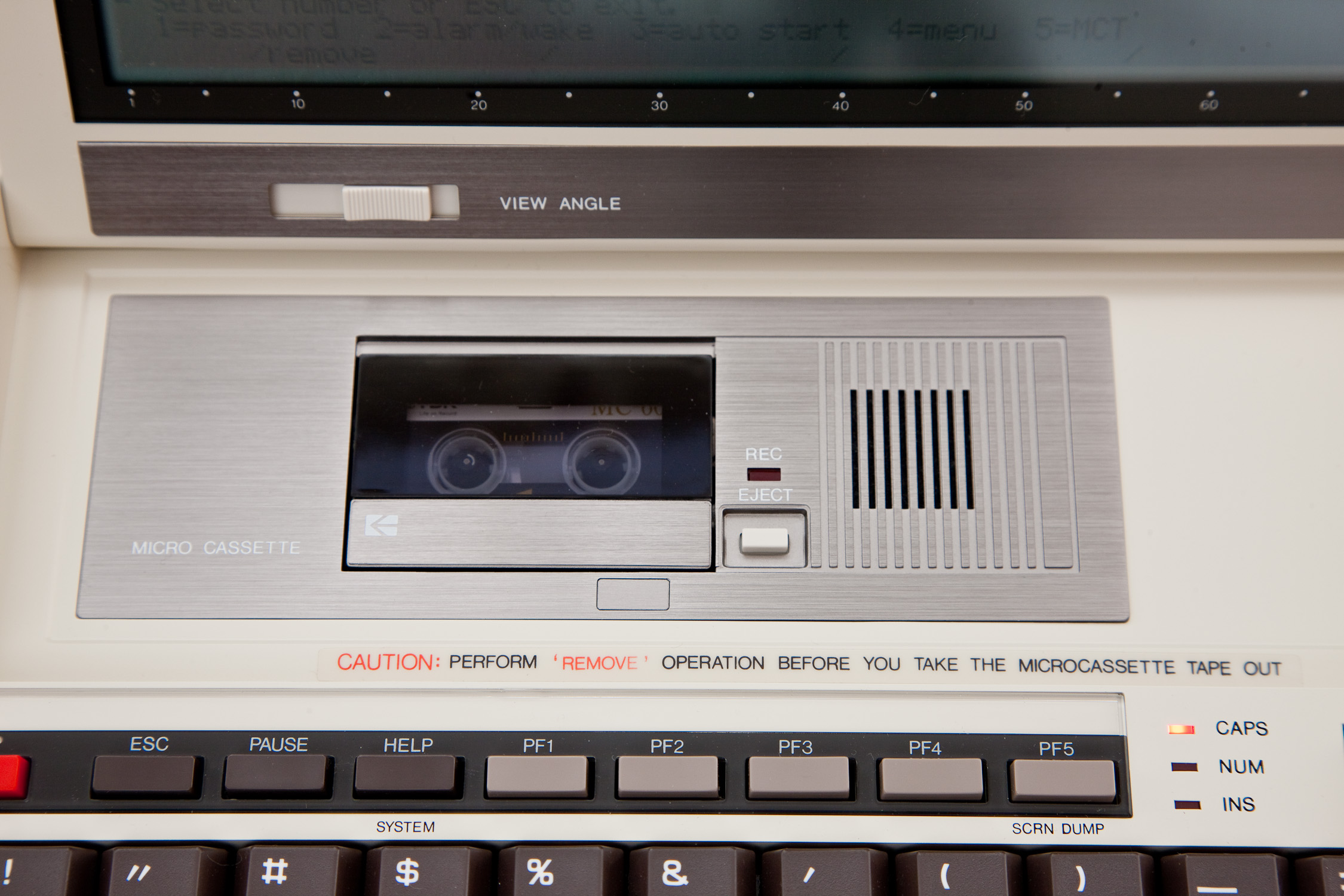
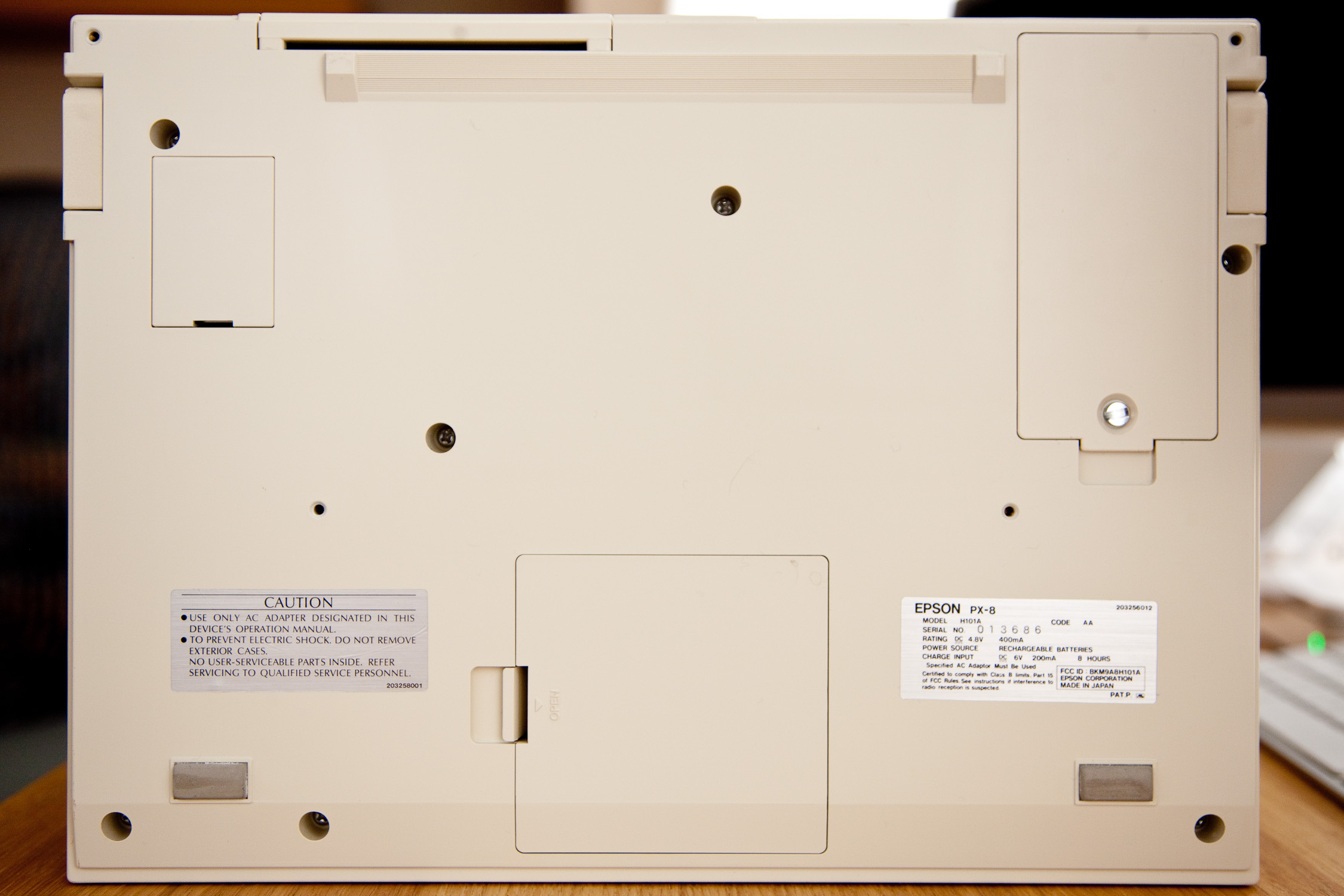
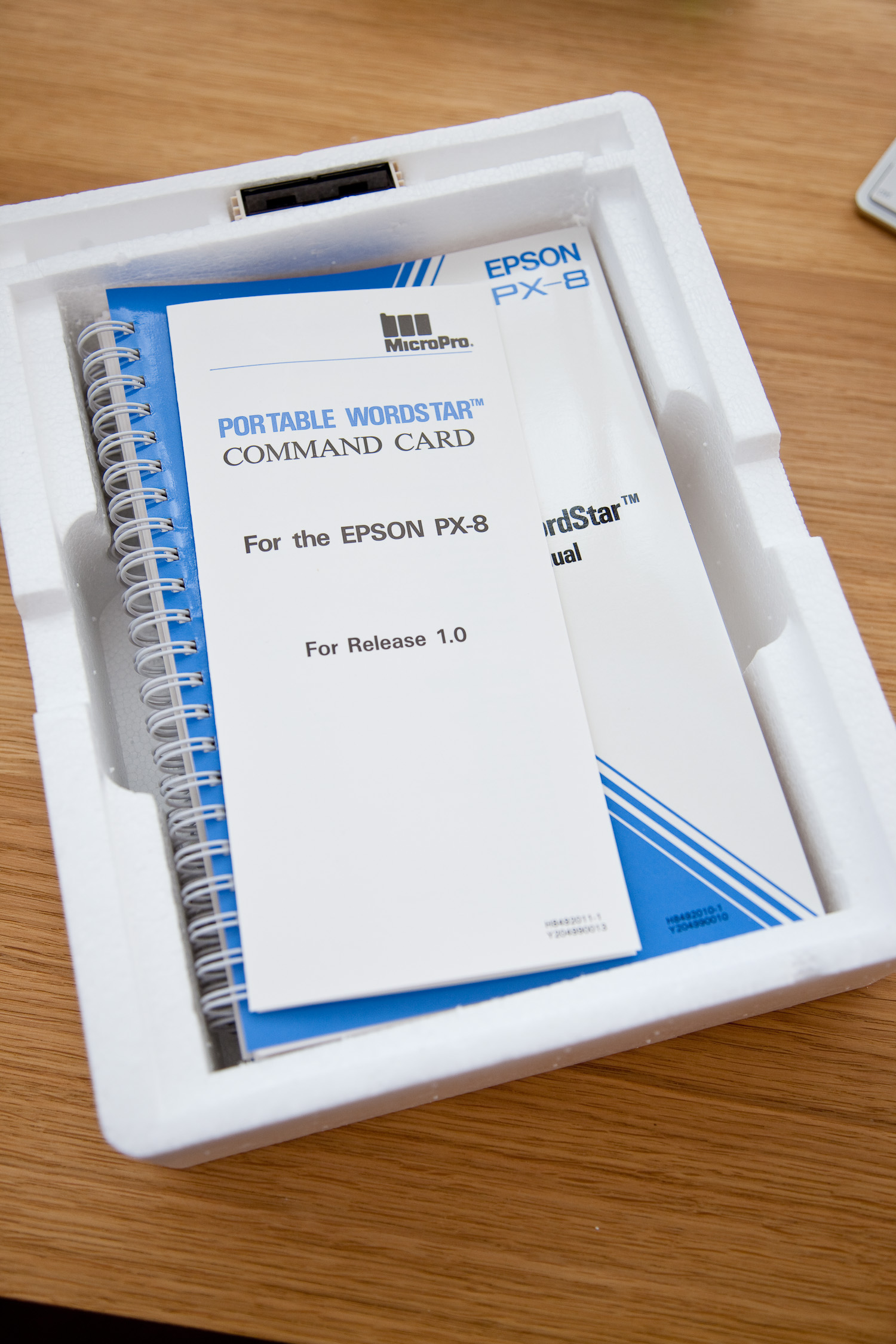
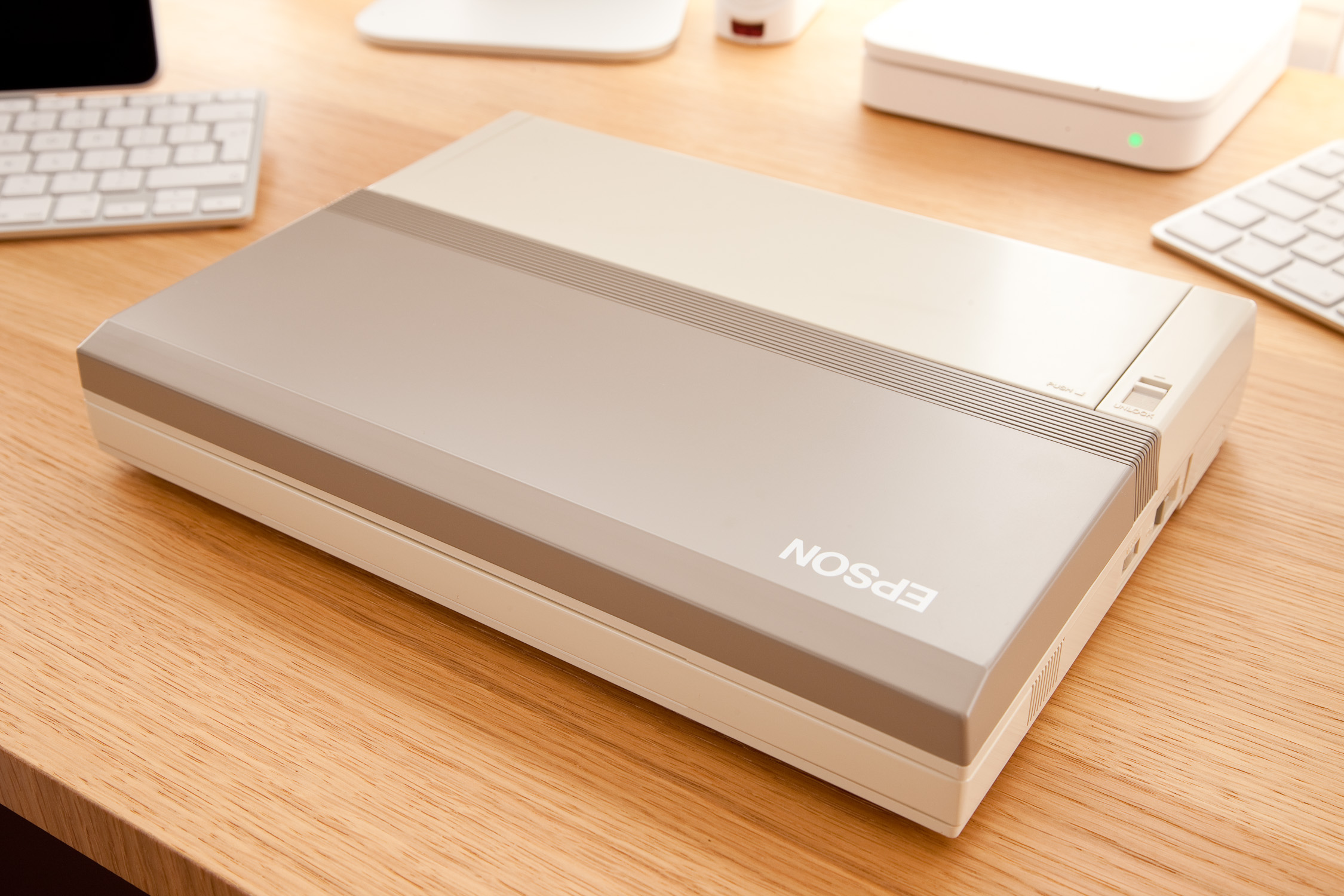
At last, the promised pictures of my new Epson PX-8 Geneva. This is a new, unused and fully boxed machine that is over 25 years old, the manuals were still shrink wrapped. The machine is in good working order although, unsurprisingly the original battery doesn’t hold a great deal of charge. However I am able to operate it with the AC adapter attached and for short periods unplugged.
I’m not an expert on battery charging but I do recall the supplier advising that the original power supply was unregulated allowing the voltage to rise above 6V when charging. The power supply I bought is regulated at 6V so whether that additional juice is needed to fully charge the battery I don’t know.
Thus far I have acquainted myself with a little CP/M which I’ve never encountered before, written a few basic BASIC programs and performed some read/write operations with the micro cassette drive which works perfectly.
The next task is to transfer some files using Filink between the PX-8 and an old DOS box which I dug out and am happy to report booted quite happily. Somewhat bizarrely the CMOS battery still seemed to be functioning as the machine reported the correct (within a few minutes) time and date.
For this file transfer task I will have to rely on the expertise of Urbancamo to make me a suitable cable as electronics/soldering were never my strong point. The RS232C port of the PX-8 utilises a 8 pin mini din socket for which I have a cable, however I believe the wiring requires some modification.
(Battery Update)
I recently read this article regarding battery charging at F J Kraan’s excellent resource for PX-8 owners which states:-
The HX-20 and PX-8 both have a four cell battery. For charging four C-type cells in series in a reasonable time, you need a higher voltage than 6 volt.
It seems pretty obvious now that the regulated adapter I bought is not providing enough voltage to charge the internal battery in a timely manner, if at all. I therefore left the unit charging for 72 hours and have found that it does now appear to be holding some charge allowing me to perform some microcassette operations without the power adapter attached. It seems I was too quick to condemn the battery supplied with the PX-8. I also have an HX-20 on its way with its original power adapter, what chance it’s compatible with the PX-8?
The PX-8 in all its undeniable glory:-
Atari Portfolio Versus Apple iPad, Sort Of…
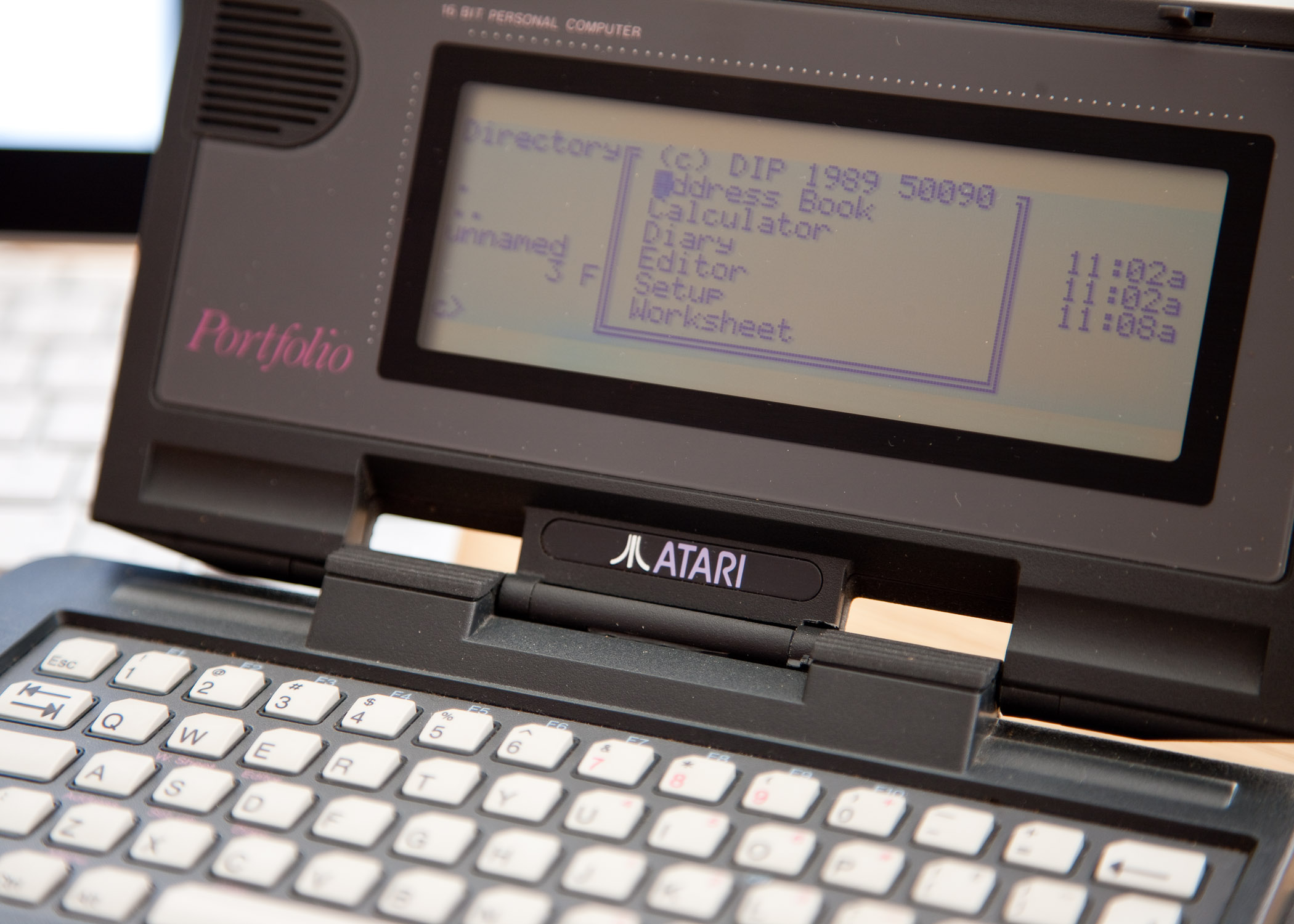
My Atari Portfolio has arrived, and what a gorgeous little thing it is indeed. I took some pictures and thought it would be interesting to include my iPad in the background. I promise I’m not neglecting my PX-8, but it’s at work as I have a Win95 box there. I will bring it home soon and take some pictures.
It might be quite amusing to do a tongue firmly in cheek, head to head review of the Portfolio versus the iPad but given that I’m supposed to be achieving something with the PX-8 (at the very least getting Filink working) it will have to wait.
The battery on the ram card (CR2016) was dead so I put in a new one and formatted the card which appears as a disk under DIP Dos. I used format a:/v (the /v switch allows you to assign a volume label after formatting.) The battery compartment sits at the top left of the card and is released by pinching the small plastic lug towards the battery tray allowing you to slide it out.
For now the Portfolio pictures.
Other Resources:-
LOIRP Article With Lots Of Images
I mentioned in an earlier entry the Lunar Orbiter Image Recovery Program (LOIRP.)
I came across this article on cnet over the weekend, it has a good deal of very interesting images and is worth checking out.
Nice to see them using Mac’s.
Commodore Vic 20 Accessories Brochure
Here are some more scans of some further promotional literature I found amongst my recent Vic 20 purchases. There are a couple of items shown that I never knew existed, probably just as well as I’d have lusted after them but would never have been able to afford them, especially the memory expansion board.
Commodore Vic 20 Brochure And Price List
Well I’ve finally managed to sort through all the items I recently ordered from Ebay including a couple of Vic 20′s, a couple of Datasettes and a whole load of cartridges, cassette games, paddles and joysticks.
Also included in one of the boxes which I thought might be of interest to some was an original Commodore UK price list from October 1982 and a brochure and other promotional literature. You have to love the fact that the floppy drive cost more than the computer. I have therefore scanned these items and included them below. If anyone has any concerns regarding copyright infringement please contact me and I’ll remove images immediately.
Demon Internet ‘tenner a month’
It occurred to me today that I couldn’t remember the last time I had received a bill from, nor indeed how I was paying for my original dial up Demon Internet service.
Back in 1993 I signed up for their then pretty revolutionary ‘tenner a month’ dial up IP service. The legendary events surrounding the birth of Demon Internet are told in detail here.
In those days I was using an Amiga 1200, a US Robotics Modem and browsing the then limited Internet with NCSA Mosaic.
Demon was very successful and quickly established itself as the UK’s largest ISP. In 1998 it’s founder Cliff Stanford sold the company to Scottish Telecom, a subsidiary of Scottish Power. Scottish Telecom was subsequently rebranded as Thus and floated on the stock exchange. More recently (2008) Thus was bought by Cable and Wireless and is now branded as Thus, A Cable and Wireless Business.
During all these changes over the past 17 years I have also moved house twice, had numerous different computers, and of course no longer use the dial up service although I’ve never cancelled the account due to the amount of services where I use the associated e-mail for log in and partly through absent mindedness.
A quick scan of my bank accounts and there of course was the direct debit, now £19.99/month the reason I hadn’t noticed it, apart from being a dufus was I also have a Demon Broadband account for work and simply hadn’t noticed there were two debits going out each month. So I headed over to http://www.demon.net to see if I could log into my account and see what details were lurking there.
However I was unable to find anywhere to log in so I called the customer services number. Armed with, well nothing really apart from my user name I spoke to a very helpful chap. It transpired that the address they had on record for me was the original address I had given in 1993 and hadn’t lived at for 12 years and the phone number was similarly out of date.
After updating my records the chap advised me to call another department as he believed as a long standing customer I should be paying less for my service and he was right. I’m now paying £4.99/month as a loyal customer as opposed to the £19.99 I was paying, quite a saving. I was also able to retrieve my account number and set up my ebilling account and view some invoices, unfortunately they only go back around 12 months.
I now wanted to discover when the price increased to £19.99/month. I noticed on the bills that I could now access that the description of the product supplied was SDU/Premier Connect PLUS (UPGRADE.) So I entered this into Google and found the following page.
Which contained the following information:-
If you are an existing SDU customer, you will need to register in order to take advantage of Demon Premier Connect Plus. In future you will be billed £19.99 instead of the £11.75 that you currently pay for your SDU account.
I do not remember asking to be upgraded to this service so I feel another call to customer services is due.
And then there’s my Pipex Dial account…
WUArchive is no more.
I noticed today, rather sadly that WUArchive is more. I don’t know the exact date it was retired, on the site it simply says 2010. Some of my earliest experiences of the Internet were rooting around on this resource using Gopher. No doubt there are mirrors of the site still out there, but presumably they will slowly disappear as the original has. The holding page to be found at the original address is a little sad though it does display the following rather limited history of the archive’s hardware.
In December of 1992, it was a DEC Alpha AXP 3000/400 workstation, with a 64bit 133Mhz 21064 Alpha CPU.
By 1997, it had 65GB of space, and 192MB of RAM.
It was a Sun UltraSparc 2, with dual 200Mhz CPUs, 512MB of RAM, and 180GB of disk in 2001.
It retired as a dual Pentium 4, with 1 GB of RAM and 1.2 TB of disk.
Things move on but there’s a strange situation with the on-line world and equally electronic game worlds both on and off-line, we inhabit these places and remember them as we do places we have physically lived or visited and yet whilst we can return to towns, cities, schools and so on once these digital worlds are dismantled or the hardware no longer exists to recreate them they are lost forever.
As more people lay down roots in the digital world it seems more people are destined eventually to be cast adrift and unable to return to those worlds as they remember them.
I often wonder for instance just what proportion of family photographs of children’s first steps, their first days at school, weddings and so on will be lost to future generations as they exist only in digital form and are subject to inevitable hardware failures and obsolete technology.
My friend Mark recently introduced me to the story of the Lunar Orbiter Image Recovery Project. A classic example of huge amounts of important data that could quite easily have been lost. It’s an extraordinary story and well worth a read and shows quite clearly the effort that can often be required to recover data stored on obsolete formats. There is clearly a window of opportunity for such projects to succeed and fortunately for the LOIRP they were just within that window.
I have today been messing around with a Vic 20 that I bought from ebay which came with the infamous Datasette. With little optimism of success I put a game cassette in, namely ‘Wacky Waiters,’ typed Load, pressed play and… it loaded with no problems. All the subsequent tapes I have tried have also worked, not bad for hardware that’s the best part of 30 years old!
As I write this entry my mind has turned to Aminet, the online repository for the Amiga community, and yes it’s still going strong, a quick root around and a couple of images I uploaded 18 years ago are still present.
The first was a render of a 3D model created by G.Dean of the 92/93 Williams Formula 1 car. Rendered with Imagine 2.0 the image took 40 minutes to complete on a 50mhz 68030 Amiga A1200 with 4 meg of fast ram.
The second image was a montage of 256 colour stills from Star Trek captured using an Amiga A1200 030 and Vidi Amiga12. The image source was a paused VHS cassette on a Panasonic NV-65 video recorder.
Epson PX-8 Geneva
The retro fire lit in my heart by my visit to the Vintage Computer Fair shows no sign of abating. On its way from the States is an unused Epson PX-8 Geneva series computer/laptop. I’ve cast my eye over a number of early 80′s machines but this (and a couple of Vic 20′s) are the first for which the wallet has been opened.
Featuring a Z-80 compatible microprocessor and a customised version of the CP/M operating system the machine uses a microcassette drive for storage and has two ROM slots into which PROMS with software such as Portable WordStar, CalcStar and Scheduler can be inserted, included with the machine are BASIC and CP/M utilities.
The machine also sports a fold out 80 column 8 line LCD display.
Pictures will of course follow and I’m looking forward to getting acquainted with CP/M. Not only is the machine absolutely gorgeous in a Silent Running kind of way but the peripherals are equally desirable. My heart is set on a PF-10 floppy drive but as far as I can tell they are very rare and difficult to source, no doubt therefore attracting a premium price.
Now I’m going to try out a PX-8 emulator created by Toshiya Takeda, here’s a gratuitous shot of it running under Windows XP on my MacPro with VMWare Fusion on OS-X Snow Leopard.
There are a number of useful resources and I’ve started to assemble a list below. I’m very thankful to all those that have taken the time to create extensive pages of information on the PX-8, they will be a great help when the machine arrives. I shall also be watching keenly Earl Evans’ Retrochallenge project to create a PX-8 virtual drive.